Genre art German Expressionism

Karl Dönselmann was a German painter and graphic artist.
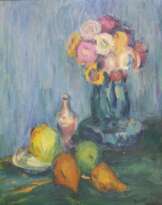
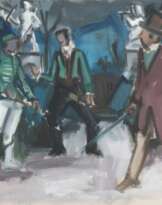
Dönselmann's works were heavily influenced by the Expressionist movement, and he often depicted scenes of everyday life, landscapes, and still lifes. He was particularly interested in the effects of light and color, and often used bold, vibrant colors in his works.
Dönselmann's works were exhibited extensively throughout Germany and internationally, and can be found in many public and private collections.

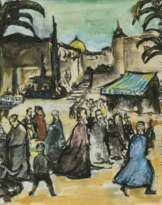

Karl-Heinz Hansen-Bahia, born in 1915 in Hamburg, Germany, was a multi-faceted artist whose work spanned various mediums, including woodblock prints, painting, sculpture, and filmmaking. His artistic journey began in earnest after World War II, with his first woodcut created in 1946. His early work, heavily influenced by the renowned artist Dürer, focused on religious scenes, showcasing his intricate and expressive style.
In 1949, Hansen-Bahia emigrated to Brazil, a move that profoundly influenced his artistic style and career. He taught art in São Paulo and later moved to Salvador Bahia, where his first exhibitions in the country were held. His work during this period began to reflect more of his adopted country's influence than his German origins, leading to a distinctive style that contributed to his prominence as a post-war German artist.
Hansen-Bahia's connection to Germany remained strong despite his move to Brazil. He returned briefly to Germany but later accepted a professorship at the Art Academy in Addis Ababa, Ethiopia. After gaining Brazilian citizenship, he continued to exhibit his work internationally, including in Europe, Japan, and the Americas. His importance in the Brazilian art scene was significant, as he became known for his portrayals of the people and landscape of the state of Bahia.
His artistic legacy was celebrated in extensive retrospectives held in Germany in 1971-72, which were among the last before his death in Brazil in 1976. Hansen-Bahia's work is a testament to his versatility and ability to adapt and evolve his style in response to his changing environments and experiences.
To stay informed about Karl-Heinz Hansen-Bahia, collectors, auctioneers, and art experts are encouraged to sign up for updates. These updates will provide information about new product sales and auction events related to Hansen-Bahia's art.
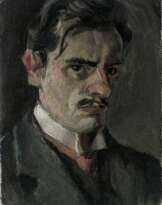
Bernhard Hasler was a German modernist painter. He was known for his expressionist paintings, especially portraits and nudes.
Hasler's work is characterized by the use of bold colours and thick, expressive strokes. He often painted portraits of friends and family. His work is marked by an emotional intensity and an exploration of the human condition.
Hasler's work can be found in many public and private collections, including the National Gallery in Berlin and the Museum of Modern Art in New York. He is considered one of the leading expressionist artists of his generation in Germany.


Paul Kayser was a German painter and graphic artist. After training as a painter-decorator, Kayser attended the Schools of Applied Art in Munich and Dresden.
Paul Kayser was a founding member of the Hamburg Artists' Club 1897 and the Hamburg Secession, and a member of the Hamburg Artists' Association and the Altona Artists' Association. His style was decisively influenced by Albert Marquet, whom Kaiser met in 1909.
In 1937, Kaiser's still life was confiscated from the museum in Husum as part of the Nazi "Degenerate Art" campaign.

Paul Kleinschmidt was a German painter, graphic artist, engraver, and draftsman.
He studied at the Berlin Academy and at the Academy in Munich, where he studied the techniques of lithography and etching. Kleinschmidt created many etchings and lithographs in the modernist style and is also known for genre images of people having fun in restaurants.
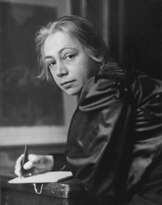
Käthe Kollwitz (born as Schmidt) was a German artist who worked with painting, printmaking (including etching, lithography and woodcuts) and sculpture. Her most famous art cycles, including The Weavers and The Peasant War, depict the effects of poverty, hunger and war on the working class. Despite the realism of her early works, her art is now more closely associated with Expressionism. Kollwitz was the first woman not only to be elected to the Prussian Academy of Arts but also to receive honorary professor status.


Lisel Oppel, actually Anna Amalie Elisabeth Oppel, was a German painter and ceramist who remains to this day one of the most memorable members of the Worpswede artist colony. From 1917 she studied painting at the Academy of Fine Arts in Munich with Richard Riemerschmid and Hermann Gröber.
Liesel Oppel painted simple paintings with great joy and colourfulness; mainly portraits, people at work and on holidays, less often pure landscapes. One of Oppel's special pictorial themes was children's pastimes in the countryside, in which she adopted and extended the motifs of the early Worpswede artists. Most of her work was created in the 1950s. She continued her expressive painting style.

Yuri Ivanovich Pimenov (Russian: Юрий Иванович Пименов) was a distinguished Russian and Soviet painter, renowned for his pivotal role in the "lyrical Thaw" movement within Soviet art. Born in Moscow in 1903, Pimenov emerged as a vital figure in the realm of Soviet impressionism, a title he embraced despite the political and artistic shifts of his time. His unique blend of realism and impressionism, often termed "realistic impressionism," showcased his versatility and defiance against abandoning his creative principles.
Pimenov's journey in the arts was marked by his participation in the OST group and later the "Isobrigade," reflecting his adaptation and response to the evolving Soviet art scene. Despite facing challenges, including a significant psychological crisis in 1931, Pimenov's resilience and dedication to art remained unwavering. His works from this period, characterized by a rose-colored palette and an optimistic view of Moscow, highlight his evolution as an artist and his ability to portray the Soviet reality through a unique lens.
Among Pimenov's notable contributions to Soviet art are masterpieces like "Wedding on Tomorrow Street," "Lyrical Housewarming," and "Japanese Girl Kyoko," each reflecting various facets of Soviet life and Pimenov's personal experiences. These works, celebrated for their vibrant storytelling and intricate details, have solidified Pimenov's legacy as a master of Soviet impressionism.
Pimenov's influence extended beyond the canvas, as he engaged deeply with the world of theater and film, designing sets and posters that further showcased his artistic versatility. His travels abroad, particularly to Japan, enriched his perspective and influenced his later works, demonstrating his global appeal and the universal resonance of his art.
For art collectors and experts, Pimenov's oeuvre represents a unique investment in the history and evolution of Soviet art. His works, a blend of political narrative and personal expression, offer a profound insight into the era of the Soviet Union, making them invaluable pieces for any collection.
To stay updated on new product sales and auction events related to Yuri Ivanovich Pimenov, sign up for our updates. This subscription is your gateway to exploring the rich legacy and enduring impact of Pimenov's art on the Soviet and global art scenes.
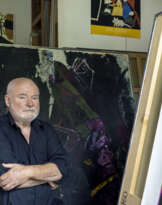

Hermann Scherer was a Swiss expressionist painter, sculptor, and printmaker. He is considered one of the most important expressionists in Switzerland.
Familiarity with new movements in art prompts the young sculptor to take up painting at the same time. Scherer switches from stone carving to painting and creates an impressive series of brightly colored works in keeping with German Expressionist trends. Inspired by the paintings of Edvard Munch, but above all by his collaboration with Ernst Ludwig Kirchner, Scherer developed an expressive formal language and painted in strong, vivid colors. The themes of his paintings speak of inner conflicts, love and passion, fear and loneliness. In addition to paintings, Scherer created many woodcuts.
In the mid-1920s, together with Paul Kamenisch and Albert Müller, Scherer founded the Rot-Blau group, which made a major contribution to Swiss expressionism.

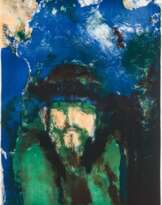
Shmuel Shapiro is an American painter and graphic artist.
The son of Jewish immigrants who came to America from Russia at the turn of the century, Shmuel Shapiro was drafted into the army during World War II and served in Europe before returning to paint again. Shapiro lived alternately in the USA, Germany, France, Switzerland and participated in exhibitions.
Shapiro's style of painting absorbed German and American expressionism, and the European influence of informal, abstract and expressionist styles is also recognizable.


Georg Tappert was a German expressionist painter.
Tappert studied at the Academy of Fine Arts in Berlin and later joined the Berlin Secession, a group of artists who sought to break away from traditional academic art. His early work was influenced by the Art Nouveau movement, but he later became associated with German Expressionism.
Tappert's paintings are characterized by their vivid colors and expressive brushstrokes, which conveyed a sense of emotional intensity. He often depicted scenes of modern urban life, such as cafés, streets, and theaters, as well as portraits and still-life compositions. He also produced a significant body of graphic work, including woodcuts and lithographs.
Tappert's work was exhibited extensively during his lifetime, including at the Berlin Secession and the Städtische Galerie in Munich. He was also awarded numerous honors and awards for his work, including the Villa Massimo Prize in Rome in 1911 and the Grand Cross of the Order of Merit of the Federal Republic of Germany in 1955.

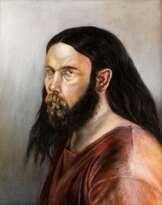

Erich Wegner was a German artist. His work was heavily influenced by the expressionist movement, and he often depicted scenes of daily life in a bold and expressive style.
Wegner's paintings were characterized by their thick brushstrokes and vibrant colors, which conveyed a sense of energy and movement. He often painted urban scenes, such as street scenes and cityscapes, and also produced numerous portraits and still-life compositions.
During the Nazi regime in Germany, Wegner's work was deemed "degenerate" and he was forbidden to exhibit his art. Despite this, he continued to work in secret and later resumed exhibiting his work after the war.
Today, Wegner's work is held in collections around the world, including the National Gallery in Berlin and the Museum of Modern Art in New York.
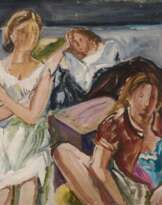
Conrad Westpfahl was a German painter. He was associated with the Expressionist movement in Germany, and his paintings often depicted the landscapes and people of rural Bavaria.
Westpfahl studied at the Academy of Fine Arts in Berlin and later became a professor at the School of Arts and Crafts in Würzburg. He was a member of the Berlin Secession, an association of artists who broke away from the traditional academic art world in the early 20th century.
Westpfahl's style was characterized by bold colors, thick brushstrokes, and a sense of emotional intensity. Later he moved on to more abstract painting.
Today, Westpfahl's paintings are held in collections around the world, including the National Gallery in Berlin and the Museum of Modern Art in New York.