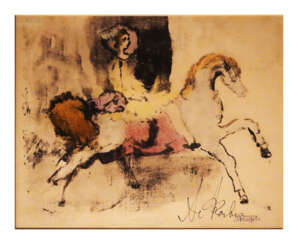
lithografie auf papier

Pablo Ruiz Picasso, a Spanish artist renowned for his revolutionary contributions to the 20th-century art scene, is a figure that resonates profoundly with collectors and art experts. His unique blend of talents in painting, sculpture, printmaking, and ceramic art, infused with his time in France, positioned him as a pivotal character in modern art history.
Picasso's artistic journey was marked by distinct periods, each showcasing his evolving style and genius. His early years were characterized by the Blue Period (1901-1904), followed by the Rose Period (1904-1906), and then the African-influenced Period (1907-1909). Picasso's name is synonymous with Cubism, a movement he co-founded, which significantly altered artistic perspectives and methods. Works like "Les Demoiselles d'Avignon" (1907) and "Guernica" (1937) are emblematic of his cubist legacy, the latter being a poignant anti-war statement that remains influential.
His later years saw a return to more traditional styles, with neoclassical and surrealist influences becoming evident. Works from these phases reflect a deep engagement with mythological themes, as seen in "Faun with Stars" (1955), symbolizing his late-life romance with Jacqueline Roque, his second wife.
Picasso's prolific output and innovative spirit made him a legend in his own time, a status that only grew after his death. His works, housed in major museums and private collections worldwide, continue to captivate and inspire.
As a collector or expert in art and antiques, staying informed about Picasso's works, their auction events, and sales is essential. To stay updated on the latest developments and opportunities related to Pablo Picasso, sign up for our specialized updates. Rest assured, this subscription will focus solely on new product sales and auction events pertaining to Picasso's art, ensuring that you receive only the most relevant and valuable information.


Yves Klein was a French artist, renowned for his innovative use of pure color and his approach to the conceptual aspects of monochrome painting. Klein, born in 1928 in Nice, France, left an indelible mark on the art world despite his brief career, which ended with his untimely death in 1962.
Klein is best known for his invention of International Klein Blue (IKB), a deep blue hue which he registered as a trademark color and used extensively in his works. This vibrant blue, which he developed in collaboration with a chemist, represented more than just a color; it was a means of evoking the immateriality and boundlessness of space. His monochrome blue canvases, large-scale public performances, and pioneering works in performance art established him as a leading figure in the Nouveau Réalisme movement in post-war Europe.
Aside from his famous blue monochromes, Klein’s Anthropometries series, where he used nude women as 'living brushes' to transfer blue paint onto canvases, is another testament to his innovative artistic methods. These performances, often accompanied by a small orchestra playing his "Monotone Symphony" — a single, continuous note played for twenty minutes followed by twenty minutes of silence — challenged traditional perceptions of the artist's role and the creation process.
Visit our gallery's website to explore more about Yves Klein and sign up for updates on new acquisitions and exclusive auction events related to his profound legacy.


Ludwig von Hofmann is a German painter, graphic artist and designer. The influence of Historicism, Art Nouveau, Symbolism and New Realism can be felt in the works of Ludwig von Hofmann at different periods of his art.
Ludwig von Hoffmann studied painting at the academies of fine arts in Dresden, Karlsruhe and Munich. Since 1898 he was a member of the cultural movement Berlin Secession.
After the National Socialists came to power in Germany, some of his works were classified as degenerate art, but most of them continued to be exhibited in museums in Germany.


Ralf Winkler, alias A. R. Penck, was a German painter, printmaker, sculptor, and jazz drummer. A neo-expressionist, he became known for his visual style, reminiscent of the influence of primitive art.


Max Beckmann, a German painter, printmaker, sculptor, and writer, stood out in the early 20th century for his profound contributions to modern art. Beckmann's career spanned a tumultuous period in history, deeply influencing his thematic and stylistic choices. Unlike many of his contemporaries who embraced non-representational painting, Max Beckmann persisted with and evolved the tradition of figurative painting, drawing inspiration from a wide array of artists spanning from Cézanne and Van Gogh to medieval masters like Bosch and Bruegel.
Max Beckmann's experiences, particularly those related to the World Wars, significantly shaped his work. Following Adolf Hitler's rise to power and the subsequent condemnation of modern art as "degenerate," Beckmann fled Germany, spending a decade in self-imposed exile in Amsterdam before eventually relocating to the United States. His art from this period, especially his large triptychs, is considered some of his most potent, offering a stark reflection on humanity and the chaos of the times.
One of Max Beckmann's most personally allegorical works, "Beginning" (1949), encapsulates his knack for blending real and imagined elements from his life to comment on the broader human condition. This piece, alongside others, underscores Beckmann's enduring fascination with the existential struggles modern society faces, teetering between desire and societal roles.
Max Beckmann's legacy is cemented not just by his unique approach to modernism but also by his influence on subsequent generations of artists, particularly in the United States, where he spent his final years teaching and working. Despite a path that often diverged from the mainstream narratives of art history, Beckmann's work continues to resonate, housed in prestigious institutions like The Museum of Modern Art and The Metropolitan Museum of Art in New York.
For collectors and experts in art and antiques, Max Beckmann's oeuvre offers a compelling exploration of 20th-century art and history. To stay informed about new discoveries, sales, and auction events related to Max Beckmann, consider signing up for updates. This subscription ensures access to the latest opportunities to engage with the work of one of modernism's most individual voices.


Max Beckmann, a German painter, printmaker, sculptor, and writer, stood out in the early 20th century for his profound contributions to modern art. Beckmann's career spanned a tumultuous period in history, deeply influencing his thematic and stylistic choices. Unlike many of his contemporaries who embraced non-representational painting, Max Beckmann persisted with and evolved the tradition of figurative painting, drawing inspiration from a wide array of artists spanning from Cézanne and Van Gogh to medieval masters like Bosch and Bruegel.
Max Beckmann's experiences, particularly those related to the World Wars, significantly shaped his work. Following Adolf Hitler's rise to power and the subsequent condemnation of modern art as "degenerate," Beckmann fled Germany, spending a decade in self-imposed exile in Amsterdam before eventually relocating to the United States. His art from this period, especially his large triptychs, is considered some of his most potent, offering a stark reflection on humanity and the chaos of the times.
One of Max Beckmann's most personally allegorical works, "Beginning" (1949), encapsulates his knack for blending real and imagined elements from his life to comment on the broader human condition. This piece, alongside others, underscores Beckmann's enduring fascination with the existential struggles modern society faces, teetering between desire and societal roles.
Max Beckmann's legacy is cemented not just by his unique approach to modernism but also by his influence on subsequent generations of artists, particularly in the United States, where he spent his final years teaching and working. Despite a path that often diverged from the mainstream narratives of art history, Beckmann's work continues to resonate, housed in prestigious institutions like The Museum of Modern Art and The Metropolitan Museum of Art in New York.
For collectors and experts in art and antiques, Max Beckmann's oeuvre offers a compelling exploration of 20th-century art and history. To stay informed about new discoveries, sales, and auction events related to Max Beckmann, consider signing up for updates. This subscription ensures access to the latest opportunities to engage with the work of one of modernism's most individual voices.


Max Beckmann, a German painter, printmaker, sculptor, and writer, stood out in the early 20th century for his profound contributions to modern art. Beckmann's career spanned a tumultuous period in history, deeply influencing his thematic and stylistic choices. Unlike many of his contemporaries who embraced non-representational painting, Max Beckmann persisted with and evolved the tradition of figurative painting, drawing inspiration from a wide array of artists spanning from Cézanne and Van Gogh to medieval masters like Bosch and Bruegel.
Max Beckmann's experiences, particularly those related to the World Wars, significantly shaped his work. Following Adolf Hitler's rise to power and the subsequent condemnation of modern art as "degenerate," Beckmann fled Germany, spending a decade in self-imposed exile in Amsterdam before eventually relocating to the United States. His art from this period, especially his large triptychs, is considered some of his most potent, offering a stark reflection on humanity and the chaos of the times.
One of Max Beckmann's most personally allegorical works, "Beginning" (1949), encapsulates his knack for blending real and imagined elements from his life to comment on the broader human condition. This piece, alongside others, underscores Beckmann's enduring fascination with the existential struggles modern society faces, teetering between desire and societal roles.
Max Beckmann's legacy is cemented not just by his unique approach to modernism but also by his influence on subsequent generations of artists, particularly in the United States, where he spent his final years teaching and working. Despite a path that often diverged from the mainstream narratives of art history, Beckmann's work continues to resonate, housed in prestigious institutions like The Museum of Modern Art and The Metropolitan Museum of Art in New York.
For collectors and experts in art and antiques, Max Beckmann's oeuvre offers a compelling exploration of 20th-century art and history. To stay informed about new discoveries, sales, and auction events related to Max Beckmann, consider signing up for updates. This subscription ensures access to the latest opportunities to engage with the work of one of modernism's most individual voices.


Auguste Herbin was a French painter, celebrated for his contributions to modern art, particularly within the realms of Cubism and abstract painting. Born on April 29, 1882, in Quiévy, Nord, France, Herbin's artistic journey took a significant turn after he moved to Paris in 1903. Initially influenced by Impressionism and Post-Impressionism, his style evolved significantly after 1909 when he became acquainted with Cubism, a movement that significantly influenced his work thereafter. By 1917, Herbin was fully immersed in creating abstract compositions, pioneering a unique blend of geometric abstraction that became his signature style. His abstract work, characterized by simple geometric shapes and vivid, unmodulated colors, adhered to a personal theory of art he detailed in his 1949 book, "L'Art non-figuratif, non-objectif".
Herbin's influence extended beyond his paintings; he was a co-founder of the groups Abstraction-Création and Salon des Réalités Nouvelles, advocating for non-figurative abstract art. Despite facing a significant challenge in 1953, when he became paralyzed on the right side and had to adapt by painting with his left hand, Herbin continued to create art until his passing on January 31, 1960, in Paris. His unfinished work, themed around the word "Fin," marks the poignant end of his prolific career.
Today, Herbin's works are housed in prestigious public collections worldwide, including the Museum de Fundatie in Zwolle, The Netherlands; Kröller-Müller Museum in Otterlo, The Netherlands; National Galleries of Scotland; Matisse Museum in Le Cateau-Cambrésis, France; and the KUNSTEN Museum of Modern Art Aalborg in Denmark, among others. These institutions celebrate Herbin's legacy, showcasing his innovative approach to abstract art that continues to inspire artists and collectors alike.
For enthusiasts and collectors interested in modern art and the evolution of abstract painting, Auguste Herbin's works offer a rich exploration of geometric abstraction and its theoretical underpinnings. Sign up for updates on new product sales and auction events related to Auguste Herbin, and delve deeper into the vibrant world of one of France's pioneering abstract artists.


Henry Spencer Moore was an influential English sculptor and artist, renowned for his semi-abstract monumental bronze sculptures that have found homes around the world as public works of art. Born on July 30, 1898, in Castleford, Yorkshire, Moore showed early talent in art, but his journey towards becoming a sculptor was not straightforward. His experiences as a young teacher and a soldier in the First World War, where he was injured in a gas attack, significantly shaped his perspectives and artistic direction.
After the war, Moore pursued his passion for art, winning a scholarship to the Royal College of Art in London, where he began to experiment with modernist influences and direct carving techniques, moving away from the traditional Victorian style. His works, characterized by organic shapes and a blend of abstraction and figuration, were inspired by a wide range of sources, including primitive art, the human body, and the natural world.
Moore's sculptures are celebrated for their unique ability to blend form with space in the landscape, offering viewers a dynamic interaction with his works. His dedication to public art made his sculptures accessible to a wide audience, contributing to his status as one of the 20th century's most significant sculptors. Moore's legacy is preserved through the Henry Moore Foundation, which supports artists and promotes public appreciation of sculpture.
For collectors and experts in art and antiques, Moore's work remains a testament to the power of sculpture to evoke emotion and thought. His contributions to modern art and sculpture continue to inspire and influence artists around the world.
To stay informed about new exhibitions and opportunities to view Henry Spencer Moore's work, sign up for updates. This subscription will ensure you are alerted to new product sales and auction events related to Moore's influential body of work.


Emil Nolde, a German-Danish artist, stands out as a pivotal figure in the Expressionist movement, celebrated for his vibrant use of color and dynamic brushwork. Born on August 7, 1867, Nolde was initially self-taught, developing a style that later became synonymous with expressive use of color and form. His early work included religious themes and landscapes, characterized by their emotional intensity and innovative color palette. Nolde's contributions to art were not limited to painting; he also excelled in printmaking, creating a significant body of work that includes etchings, woodcuts, and lithographs.
One of Nolde's most noteworthy periods was his time spent on the Baltic Sea island of Alsen from 1903 to 1916, where he produced seascapes that captured the natural world's dynamic essence. His painting "Meer Bei Alsen" (Sea Off Alsen) is a testament to this period, showcasing his ability to convey movement and emotion through color. Furthermore, Nolde's fascination with religious and mythological themes is evident in works like "Dance Around the Golden Calf," where he employs vivid colors and expressive figures to explore complex narratives.
Despite his artistic achievements, Nolde's life was not without controversy. During the Nazi regime, his work was labeled "degenerate," and he faced significant professional and personal challenges. Nonetheless, Nolde continued to create, producing a series of watercolors known as the "Unpainted Pictures" during this time. After World War II, Nolde's reputation was rehabilitated, and he was once again celebrated as a leading figure in modern art.
Nolde's legacy is preserved at the Nolde Foundation Seebüll, a museum dedicated to his life and work, established in the year of his death, 1956. His influence on the field of modern art, particularly within Expressionism, is undeniable, with his bold approach to color and form inspiring subsequent generations of artists.
For art collectors and experts, Nolde's work offers a compelling study in the evolution of modern art, reflecting the tumultuous times he lived through and his unyielding dedication to artistic expression. His ability to capture the essence of his subjects, from the natural beauty of the sea to the depths of human emotion, makes his work a valuable addition to any collection.
To stay updated on sales and auction events related to Emil Nolde's work, signing up for updates is recommended. This subscription service ensures you're informed about the latest opportunities to acquire pieces by this influential artist.


Kurt Schwitters (1887–1948) was a German artist renowned for his multifaceted contributions to modern art, encompassing painting, poetry, graphic design, and installation art. Born in Hanover, Germany, Schwitters developed a unique artistic vision that led to the creation of "Merz," a term he coined to describe his one-of-a-kind approach to art.
The concept of Merz originated from a fragment of the word "Kommerz" (commerce), which Schwitters incorporated into his early collages. This term came to represent his artistic philosophy, characterized by the assemblage of found objects and everyday materials into cohesive compositions. Through Merz, Schwitters sought to blur the boundaries between traditional art forms, integrating elements of Dadaism, Constructivism, and Surrealism.
One of Schwitters' most significant projects was the "Merzbau," an ambitious, evolving installation within his Hanover home. This project began around 1923 and transformed his living space into a labyrinthine structure filled with collages, sculptures, and found objects. The Merzbau was a physical manifestation of his Merz philosophy, embodying the synthesis of art and life. Unfortunately, the original Merzbau was destroyed during a British air raid in 1943.
In addition to his visual art, Schwitters made notable contributions to literature and sound art. His poem "An Anna Blume," published in 1919, is a seminal work that exemplifies his playful use of language and nonsensical style, aligning with the Dada movement's principles. Moreover, his "Ursonate," a sound poem composed between 1922 and 1932, showcases his innovative exploration of phonetic expression and rhythm, pushing the boundaries of traditional poetry.
The rise of the Nazi regime in Germany had a profound impact on Schwitters' life and work. Classified as a "degenerate" artist by the Nazis, he fled to Norway in 1937 to escape persecution. Following the German invasion of Norway in 1940, he sought refuge in the United Kingdom. During his internment at the Hutchinson Internment Camp on the Isle of Man, Schwitters continued to create art, producing over 200 works during his 16 months of confinement.
After his release, Schwitters settled in the Lake District of England, where he embarked on a new Merz construction known as the "Merzbarn." Although he was unable to complete this project due to his death in 1948, the Merzbarn stands as a testament to his unwavering commitment to his artistic vision. Today, Kurt Schwitters is celebrated as a pioneer of modern art, whose innovative techniques and ideas have left an indelible mark on the art world.


Horst Antes was a German painter, graphic artist and sculptor, a pioneer of the new figurative painting in Germany.
After studying at the Karlsruhe Academy of Fine Arts from 1957 to 1959, Antes taught there himself and later became a professor there.
Antes became known for the Kopffüßler (head-foot) image, which has been a recurring theme in his paintings, sculptures and graphic works since the early 1960s. Antes' work is represented in several major collections in Berlin, Hamburg, Cologne and elsewhere in Germany.


Italo Valenti was an Italian painter of the Informel.


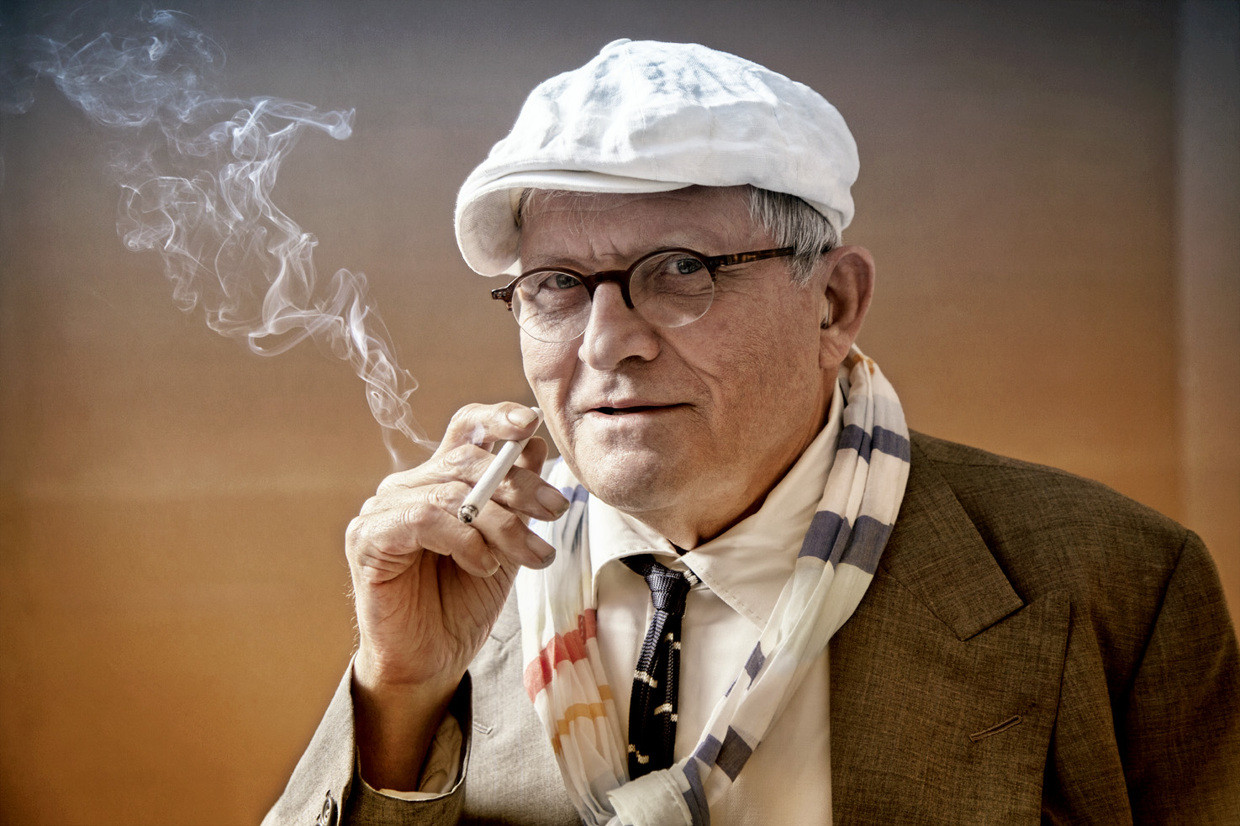
David Hockney, a British artist, has been a prominent figure in the art world for over six decades, renowned for his contributions to painting, drawing, printmaking, photography, and video art. His exploration of these mediums has made significant impacts on the Pop Art movement and beyond, making him one of the most influential artists of the 20th and 21st centuries. Hockney's work is celebrated for its vibrant color palette, emotional depth, and innovative use of technology in art.
One of Hockney's most distinctive features is his ability to blend traditional techniques with modern technology, notably in his iPad drawings and photographic collages. This fusion not only showcases his skillful adaptation to contemporary mediums but also highlights his ongoing quest to explore the nature of seeing and representation in art. Hockney's landscapes and portraits, characterized by their bright colors and meticulous detail, invite viewers to see the world through his unique perspective.
Significant works by Hockney, such as "A Bigger Splash" and "Portrait of an Artist (Pool with Two Figures)," are housed in major museums and galleries worldwide, attesting to his global influence and appeal. These pieces, among others, demonstrate Hockney's mastery over space, light, and narrative, securing his position as a pivotal figure in modern and contemporary art.
For collectors and experts in art and antiques, Hockney's oeuvre presents a fascinating study in the evolution of visual arts. His work not only offers insight into the artist's personal vision but also reflects broader cultural and technological shifts in society. As interest in Hockney's art continues to grow, keeping abreast of new sales and auction events becomes increasingly valuable.
To stay informed about the latest David Hockney sales and auction events, sign up for our updates. This subscription ensures that you receive timely notifications about new product sales and auction events related to David Hockney, offering unique opportunities for collectors and enthusiasts alike.


Käthe Kollwitz (born as Schmidt) was a German artist who worked with painting, printmaking (including etching, lithography and woodcuts) and sculpture. Her most famous art cycles, including The Weavers and The Peasant War, depict the effects of poverty, hunger and war on the working class. Despite the realism of her early works, her art is now more closely associated with Expressionism. Kollwitz was the first woman not only to be elected to the Prussian Academy of Arts but also to receive honorary professor status.