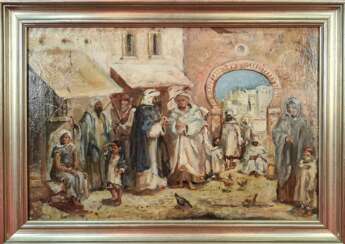
morocco


Charles Dickens, full name Charles John Huffam Dickens, is the most famous British writer of the Victorian era, a classic of world literature.
From childhood the future writer learned all the hardships of life in poverty: his father in prison for debts, hard work in a factory. Then service stenographer in court and reporter developed in him a strong attachment to journalism and contempt for both the law and parliament.
Dickens had many talents: in addition to literary work, he was an actor, published periodicals, arranged numerous literary readings, where he reveled in the admiration and love of the public. Fecund and versatile, Charles Dickens wrote many brilliant and often comic works. His novels cover a wide range of social, moral, emotional and other aspects. As a subtle psychologist, he is also very interested in the most ordinary people, but also the eccentric, the flawed, and even the insane.
Dickens was immensely popular around the world during his lifetime. His intellect, worldview, and deep reflections on society and its faults enriched his novels and made him one of the great figures of nineteenth-century literature, an influential spokesman for the conscience of his time.
Dickens' best-known and most popular novels are The Pickwick Club Posthumous Notes, Oliver Twist, Nicholas Nickleby, David Copperfield, Cold House, A Tale of Two Cities, Our Mutual Friend, Great Expectations, and The Mystery of Edwin Drood.


Nicolaus Copernicus (Polish: Mikołaj Kopernik) was a Polish and German scientist, astronomer, mathematician, mechanic, economist, and Renaissance canonist. He was the author of the heliocentric system of the world, which initiated the first scientific revolution.
Copernicus studied the humanities, including astronomy and astrology, at the University of Krakow and at the University of Bologna in Italy. Together with other astronomers, including Domenico Maria de Novara (1454-1504), he was engaged in observing the stars and planets, recording their movements and eclipses. At the time, medicine was closely related to astrology, as the stars were believed to influence the human body, and Copernicus also studied medicine at the University of Padua between 1501 and 1503.
Nicolaus Copernicus, based on his knowledge and observations, was the first to suggest that the Earth is a planet that not only revolves around the sun every year, but also rotates once a day on its axis. This was in the early 16th century when people believed the Earth to be the center of the universe. The scientist also suggested that the Earth's rotation explained the rising and setting of the Sun, the movement of the stars, and that the cycle of the seasons was caused by the Earth's rotation around itself. Finally, he correctly concluded that the Earth's motion in space causes the planets to move backwards across the night sky, the so-called retrograde direction.
Although Copernicus' model was not completely correct, it laid a solid foundation for future scientists, such as Galileo, who developed and improved mankind's understanding of the motion of celestial bodies. Copernicus completed the first manuscript of his book De Revolutionibus Orbium Coelestium (On the Rotation of the Celestial Spheres) in 1532. In it, the astronomer outlined his model of the solar system and the paths of the planets. However, he published the book only in 1543, just two months before his death, and dedicated it to Pope Paul III. Perhaps for this reason, and also because the subject matter was too difficult to understand, but the church did not finally ban the book until 1616.


Johannes Kepler was a German mathematician and astronomer who discovered that the Earth and planets move around the Sun in elliptical orbits.
Kepler created the three fundamental laws of planetary motion. He also did seminal work in optics and geometry, calculated the most accurate astronomical tables, and made many inventions and discoveries in physics on which further scientific discoveries by advanced scientists were based.


Isaac Newton was an English mathematician, physicist, astronomer, alchemist, theologian, and author (described in his time as a "natural philosopher"), widely recognised as one of the greatest mathematicians and physicists and among the most influential scientists of all time. He was a key figure in the philosophical revolution known as the Enlightenment. His book Philosophiæ Naturalis Principia Mathematica (Mathematical Principles of Natural Philosophy), first published in 1687, established classical mechanics. Newton also made seminal contributions to optics, and shares credit with German mathematician Gottfried Wilhelm Leibniz for developing infinitesimal calculus.
In the Principia, Newton formulated the laws of motion and universal gravitation that formed the dominant scientific viewpoint until it was superseded by the theory of relativity. Newton used his mathematical description of gravity to derive Kepler's laws of planetary motion, account for tides, the trajectories of comets, the precession of the equinoxes and other phenomena, eradicating doubt about the Solar System's heliocentricity. He demonstrated that the motion of objects on Earth and celestial bodies could be accounted for by the same principles. Newton's inference that the Earth is an oblate spheroid was later confirmed by the geodetic measurements of Maupertuis, La Condamine, and others, convincing most European scientists of the superiority of Newtonian mechanics over earlier systems.


René Descartes was a French philosopher, mathematician, and natural scientist who is considered the founder of modern philosophy.
Descartes was a very versatile scientist: besides numerous philosophical reflections, he wrote works on optics, meteorology and geometry. Contemporaries noted his extensive knowledge in many sciences. Descartes owns the famous saying "I think, therefore I exist" (best known in the Latin formulation "Cogito, ergo sum", although it was originally written in French: "Je pense, donc je suis").
He developed a metaphysical dualism that radically distinguished between mind, whose essence is thought, and matter, whose essence is extension in three dimensions. Descartes' metaphysics is rationalistic, based on the postulation of innate ideas of mind, matter, and God, but his physics and physiology, based on sense experience, are mechanistic and empirical.
Unlike his scientific predecessors, who felt a holy awe at the incomprehensibility of the divine essence of the universe, Descartes admired the ability of the human mind to understand the cosmos and to generate happiness itself, and rejected the view that human beings were inherently unhappy and sinful. He believed that it was inappropriate to pray to God to change the state of things and the world; it was much more productive to change oneself.


Mark Twain, real name Samuel Langhorne Clemens, was an American humanist writer, journalist, and social activist.
As a young man, Samuel worked in the printing press and in the gold mines, then went on a steamboat trip to Europe and the "Holy Land". His travel letters, full of vivid descriptions and ironic observations, were very well received by the public and were later revised into his first book, Innocents Abroad, published in 1869.
The pseudonym "Mark Twain" first appeared in 1863 under one of Samuel Clemens' short stories, and since then all his significant works have been signed by that name.
A talented storyteller, a peculiar humorist and moralist, Twain knew and loved his many diverse characters. His scandalizers and dreamers, caring aunts and ambitious politicians, grumpy widows and lying aristocrats, cunning but generous slaves, sentimental moralists, brave and naive children - all these types of American people Twain gave voice to thanks to his masterful command of colloquial language, slang and jargon. Twain wrote a lot and in a variety of genres: humor and satire, philosophical fiction and journalism and others, but he always stood on the position of humanist and democrat.
Mark Twain became world famous for his travel stories and adventure novels about his childhood, these are "The Adventures of Tom Sawyer" (1876) and "The Adventures of Huckleberry Finn" (1885). Twain is still one of America's, and indeed the world's, best and most beloved writers. His works have been and are still being published in many languages around the world.


![The Holy Land, Syria, Idumea, Arabia, Egypt & Nubia [With:] Egypt & Nubia](/assets/image/picture_5228522/f2c4a/62c2300fe14f52f338500e3ccd12d6bd1769094000jpg__fix_374_244.jpeg)
![The Holy Land, Syria, Idumea, Arabia, Egypt & Nubia [With:] Egypt & Nubia](https://veryimportantlot.com/assets/image/picture_5228522/f2c4a/62c2300fe14f52f338500e3ccd12d6bd1769094000jpg__fix_374_244.jpeg)