









offsetdruck

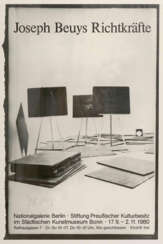
Joseph Heinrich Beuys was a German artist, renowned for his significant contributions to the realms of sculpture, painting, and installation art, which have left a lasting impact on the culture and art world. His work transcended traditional boundaries, merging art with social theory and politics, thus redefining the role of the artist in society. Beuys's unique approach to materials, incorporating substances like fat and felt, symbolized healing and insulation, reflecting his broader philosophical and ecological concerns.
Beuys's art was deeply influenced by his experiences during World War II and his academic background in natural sciences and sculpture. His concept of "social sculpture" proposed that art could transform society, emphasizing creativity as a fundamental component of human existence. This vision led him to use his performances, or "actions," as a medium to communicate his ideas, making him a pivotal figure in the Fluxus movement. Notable works such as "How to Explain Pictures to a Dead Hare" and "7000 Oaks" exemplify his innovative use of performance and environmental art to engage and challenge the public.
His legacy is preserved in major museums and galleries worldwide, including the Museum of Modern Art in New York and the Tate Modern in London. These institutions house key pieces that exemplify Beuys's diverse artistic output, from his early drawings and sculptures to his later installations and public interventions. His influence extends beyond the art world, impacting environmental activism and educational reform, underscoring his belief in the transformative power of art.
For collectors and experts in art and antiques, Joseph Heinrich Beuys remains a figure of immense interest, not only for his groundbreaking artworks but also for his profound impact on contemporary art theory and practice. To stay informed about new product sales and auction events related to Beuys, we invite you to sign up for updates. This subscription ensures you are always in the loop regarding opportunities to engage with the enduring legacy of one of the most influential artists of the 20th century.


Ilya Iosifovich Kabakov (Russian: Илья́ Ио́сифович Кабако́в) was a seminal Russian-American conceptual artist, celebrated for his profound contributions to the art world, particularly through installations that critically examined Soviet life and the broader themes of human existence. Born on September 30, 1933, in Dnipropetrovsk, Ukrainian SSR, Kabakov's early life during the tumultuous World War II era and subsequent education at the V.I. Surikov State Art Institute in Moscow shaped his perspective and artistic expression. His nuanced critiques of the Soviet regime, combined with his exploration of utopian projects—including capitalism—through his art, positioned him as a pivotal figure in the dialogue between Eastern and Western artistic traditions.
Kabakov's partnership with Emilia Kanevsky, who later became his wife, led to a dynamic collaboration that spanned decades, producing influential exhibitions globally, including notable showcases at the Documenta in 1992, the Venice Biennale in 1993, and the Tate Modern in 2017. Their work is characterized by the use of fictional narratives, which often drew upon Kabakov's personal experiences to explore the life cycle of the Soviet Union, positioning it not merely as a failed socialist experiment but as one among many utopian visions susceptible to the authoritarian will to power.
Throughout his career, Kabakov never shied away from the complexity of the human condition, as evidenced by his installations like "The Man Who Flew Into Space From His Apartment" and "The Toilet," which resonate with viewers for their depth and the universality of their themes. His artworks are part of the collections of prestigious institutions such as the Museum of Modern Art, the Centre Pompidou, and the State Hermitage Museum, underscoring his significant impact and enduring legacy in the art world.
Kabakov's death on May 27, 2023, at the age of 89, marked the end of a prolific career that left an indelible mark on the landscape of conceptual art. His work continues to inspire and provoke thought, bridging the gap between personal narrative and global history, and inviting viewers to reconsider their perspectives on society, history, and the role of art in reflecting and shaping human experience.
For collectors and experts in art and antiques interested in staying updated on exhibitions and auctions related to Ilya Iosifovich Kabakov, signing up for updates can provide exclusive insights and opportunities to engage with his impactful body of work. This subscription ensures that enthusiasts are well-informed about new sales and events, allowing them to deepen their appreciation for Kabakov's artistic contributions.