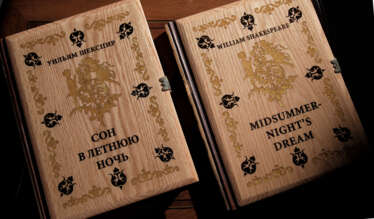
printed editions

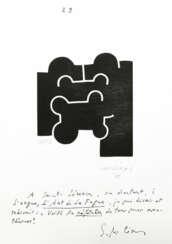
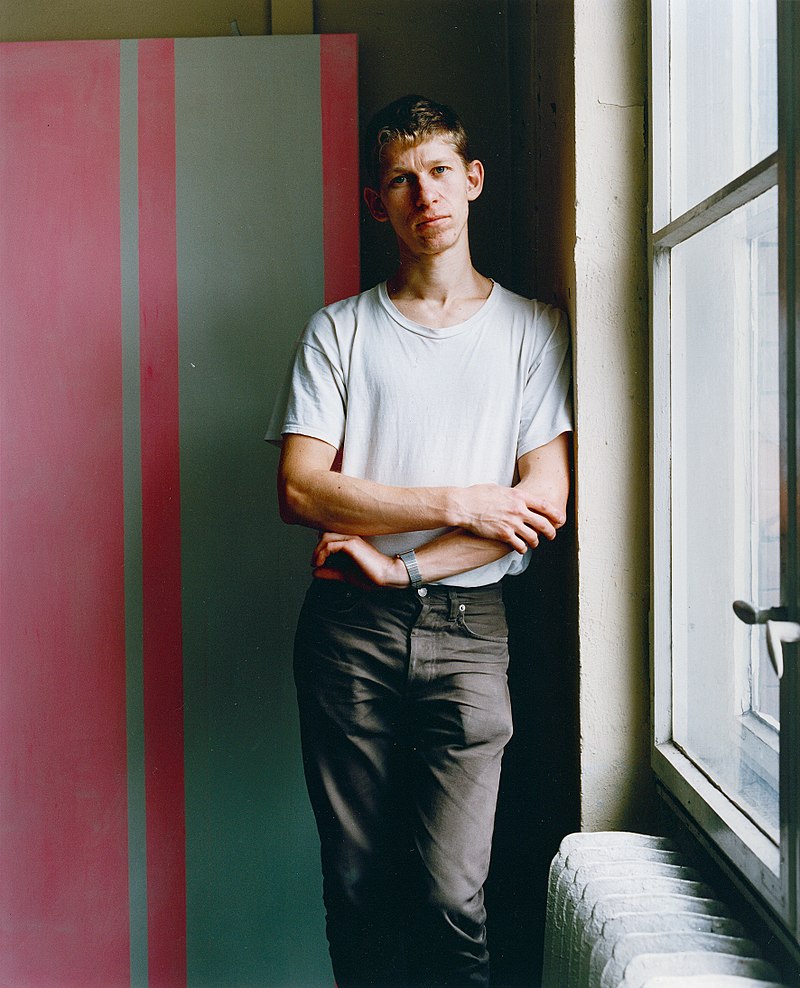
Horst Antes was a German painter, graphic artist and sculptor, a pioneer of the new figurative painting in Germany.
After studying at the Karlsruhe Academy of Fine Arts from 1957 to 1959, Antes taught there himself and later became a professor there.
Antes became known for the Kopffüßler (head-foot) image, which has been a recurring theme in his paintings, sculptures and graphic works since the early 1960s. Antes' work is represented in several major collections in Berlin, Hamburg, Cologne and elsewhere in Germany.


Alan Alexander Milne was a British journalist, playwright and children's author.
While studying at Trinity College, Cambridge, Milne began writing for Granta magazine, and in 1906 he joined the humor magazine Punch, where he wrote humorous poems and quirky essays until 1914. During World War I he served as a communications officer, and afterward, in 1920, Milne had a son, Christopher Robin, whose name soon became known to the world.
From 1921 Milne wrote several comedy plays and also began writing children's poetry and prose for his young son, having finally found his calling. Milne's major successes were his books Winnie the Pooh (1926) and The House on Pooh Corner (1928). These two volumes tell the adventures of a boy named Christopher Robin and his playmates - animals that were "born" from the toys of the real Christopher Robin. The central character is Winnie the Pooh Bear, accompanied by the fussy Rabbit, the sullen Donkey Ia, the bouncy tiger Tigger, the kind kangaroo Kanga and her baby Roo, the wise Owl and the timid Piglet. The adventures of Pooh and his friends in the forest of One Hundred Acres with illustrations by Ernest Shepard became bestsellers.
They were translated into different languages of the world and reprinted many times, filmed cartoons. In 1929 Milne adapted another children's classic, Kenneth Graham's The Wind in the Willows, for stage production as Toad of Toad Hall. Ten years later he wrote an autobiography, Now It's Too Late.


Galileo Galilei was an Italian naturalist, physicist, mechanic, astronomer, philosopher, and mathematician.
Using his own improved telescopes, Galileo Galilei observed the movements of the Moon, Earth's satellites, and the stars, making several breakthrough discoveries in astronomy. He was the first to see craters on the Moon, discovered sunspots and the rings of Saturn, and traced the phases of Venus. Galileo was a consistent and convinced supporter of the teachings of Copernicus and the heliocentric system of the world, for which he was subjected to the trial of the Inquisition.
Galileo is considered the founder of experimental and theoretical physics. He is also one of the founders of the principle of relativity in classical mechanics. Overall, the scientist had such a significant impact on the science of his time that he cannot be overemphasized.


Johannes Kepler was a German mathematician and astronomer who discovered that the Earth and planets move around the Sun in elliptical orbits.
Kepler created the three fundamental laws of planetary motion. He also did seminal work in optics and geometry, calculated the most accurate astronomical tables, and made many inventions and discoveries in physics on which further scientific discoveries by advanced scientists were based.


Abraham Ortelius (Ortels) was a Brabantian cartographer, geographer, and cosmographer. He is recognized as the creator of the first modern atlas, the Theatrum Orbis Terrarum (Theatre of the World). Along with Gemma Frisius and Gerardus Mercator, Ortelius is generally considered one of the founders of the Netherlandish school of cartography and geography. He was a notable figure of this school in its golden age (approximately 1570s–1670s) and an important geographer of Spain during the age of discovery. The publication of his atlas in 1570 is often considered as the official beginning of the Golden Age of Netherlandish cartography. He was the first person proposing that the continents were joined before drifting to their present positions. Beginning as a map-engraver, in 1547 he entered the Antwerp Guild of Saint Luke as an illuminator of maps. In 1560 when travelling with Mercator to Trier, Lorraine, and Poitiers, he seems to have been attracted, largely by Mercator's influence, towards the career of a scientific geographer. In 1564 he published his first map, Typus Orbis Terrarum, an eight-leaved wall map of the world. On 20 May 1570, Gilles Coppens de Diest at Antwerp issued Ortelius's Theatrum Orbis Terrarum, the "first modern atlas" (of 53 maps).


Albert Einstein was a German-born theoretical physicist, widely acknowledged to be one of the greatest and most influential physicists of all time. Einstein is best known for developing the theory of relativity, but he also made important contributions to the development of the theory of quantum mechanics. Relativity and quantum mechanics are together the two pillars of modern physics. His mass–energy equivalence formula E = mc2, which arises from relativity theory, has been dubbed "the world's most famous equation". His work is also known for its influence on the philosophy of science. He received the 1921 Nobel Prize in Physics "for his services to theoretical physics, and especially for his discovery of the law of the photoelectric effect", a pivotal step in the development of quantum theory. His intellectual achievements and originality resulted in "Einstein" becoming synonymous with "genius".


Johannes Kepler was a German mathematician and astronomer who discovered that the Earth and planets move around the Sun in elliptical orbits.
Kepler created the three fundamental laws of planetary motion. He also did seminal work in optics and geometry, calculated the most accurate astronomical tables, and made many inventions and discoveries in physics on which further scientific discoveries by advanced scientists were based.


Johannes Kepler was a German mathematician and astronomer who discovered that the Earth and planets move around the Sun in elliptical orbits.
Kepler created the three fundamental laws of planetary motion. He also did seminal work in optics and geometry, calculated the most accurate astronomical tables, and made many inventions and discoveries in physics on which further scientific discoveries by advanced scientists were based.


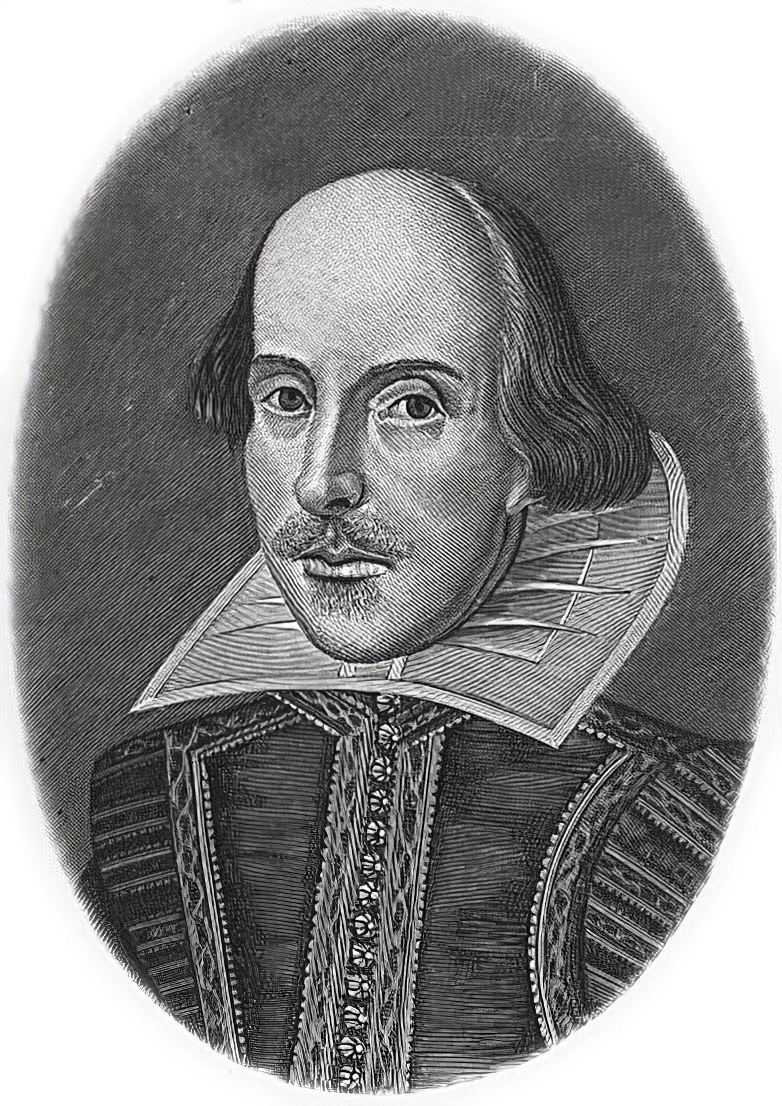
William Shakespeare was a British poet and playwright and writer.
William's father, John Shakespeare, was a merchant and official in Stratford. There are reports that he was a sailor for a time before joining a theater company in London. Beginning in the 1590s, Shakespeare began writing plays, and in 1593 he published a poem, Venus and Adonis, which became popular. He dedicated it to the Duke of Southampton, who was a philanthropist and patron of talent, and soon his business was booming.
From 1592 to 1600 Shakespeare wrote his dramas and romantic comedies "Richard III", "The Taming of the Shrew", "Romeo and Juliet", "A Midsummer Night's Dream" and "The Merchant of Venice", as well as the comedies "Much Ado About Nothing", "Twelfth Night" and the tragedy "Julius Caesar". The playwright's business was so successful that he even bought a large house in Stratford. In 1599, Shakespeare became one of the owners, playwright and actor of the new theater "Globe". In 1603 King James took Shakespeare's troupe under his direct patronage. In the mature period, the great playwright turned to tragedies, there were "Hamlet", "Othello", "King Lear", "Macbeth" and others.
Although in the 19th century researchers had some doubts about the authorship of many of these works, William Shakespeare is considered the greatest English playwright, one of the best playwrights in the world. His plays have been translated into all major languages and to this day form the basis of the world theatrical repertoire, most of them have been screened many times. According to the Guinness Book of Records, Shakespeare remains the world's best-selling playwright, and his plays and poems have sold more than 4 billion copies in the nearly 400 years since his death.

Galileo Galilei was an Italian naturalist, physicist, mechanic, astronomer, philosopher, and mathematician.
Using his own improved telescopes, Galileo Galilei observed the movements of the Moon, Earth's satellites, and the stars, making several breakthrough discoveries in astronomy. He was the first to see craters on the Moon, discovered sunspots and the rings of Saturn, and traced the phases of Venus. Galileo was a consistent and convinced supporter of the teachings of Copernicus and the heliocentric system of the world, for which he was subjected to the trial of the Inquisition.
Galileo is considered the founder of experimental and theoretical physics. He is also one of the founders of the principle of relativity in classical mechanics. Overall, the scientist had such a significant impact on the science of his time that he cannot be overemphasized.