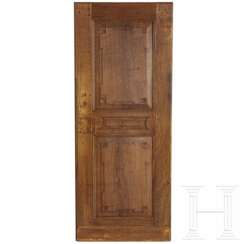
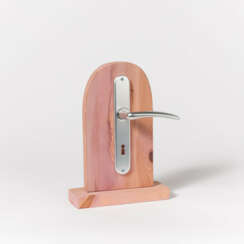




tür


Uwe Henneken is a German artist living and working in Berlin.
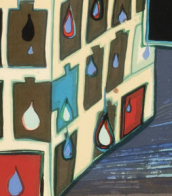
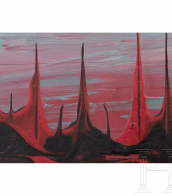
Henneken began his studies at the State Academy of Fine Arts in Karlsruhe and completed his studies at the University of the Arts in Berlin. In his grotesque, amusing and fabulous paintings and sculptures, the artist transports the viewer into strange worlds. Especially impressive are the brightly colored landscapes, as in a surrealistic fever dream. In these psychedelic sets move figures unimaginable in reality, sometimes comic and cartoonish, sometimes tragic, and sometimes both at the same time.
Henneken has spent a lifetime researching the theme of shamanism and believes that the shaman is the prototype of the artist and therefore the contemporary artist is directly connected to his professional ancestor. Promoting the idea of otherworlds, through magical realism the artist brings magic to real life.


Willem Grimm was a German painter and graphic artist.
Already during his studies he made a name for himself, especially with his experimental graphics. After several guest exhibitions at the Hamburg Secession, he became an official member in 1929/30. In the early 1930s, at the age of 27, he was already one of Hamburg's most important artists.
In addition to classical genres such as portraits, landscapes and still lifes, Grimm worked from 1931 on the Rummelpott-Szenen motif, which in time became characteristic of his work.
The National Socialist repressions affected Willem Grimm less than many of his fellow artists. Still, in 1937 seven of Grimm's works were confiscated from the Kunsthalle Hamburg, the Hamburg Arts and Crafts Museum and the Nissenhaus Husum Museum as part of the "Degenerate Art" campaign and subsequently destroyed.


Willem Grimm was a German painter and graphic artist.
Already during his studies he made a name for himself, especially with his experimental graphics. After several guest exhibitions at the Hamburg Secession, he became an official member in 1929/30. In the early 1930s, at the age of 27, he was already one of Hamburg's most important artists.
In addition to classical genres such as portraits, landscapes and still lifes, Grimm worked from 1931 on the Rummelpott-Szenen motif, which in time became characteristic of his work.
The National Socialist repressions affected Willem Grimm less than many of his fellow artists. Still, in 1937 seven of Grimm's works were confiscated from the Kunsthalle Hamburg, the Hamburg Arts and Crafts Museum and the Nissenhaus Husum Museum as part of the "Degenerate Art" campaign and subsequently destroyed.