



ID 1540260
Los 11 | Mysterium cosmographicum
Schätzwert
$ 80 000 – 120 000
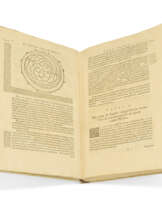
First edition of Kepler's first substantial work—the innovative Copernican treatise that launched his career and sowed the seeds of his revolutionary transformation of astronomy, from Frederick the Great's library. Although Kepler had originally desired to become a pastor, the terms of his scholarship at Tübingen obligated him to take a post as a mathematics teacher in Graz in 1594. While teaching his students there, he had an epiphany which ultimately produced this remarkable Platonic-Pythagorean approach to the geometrical structure of the universe:
"Kepler demonstrated that by nesting the Platonic solids one inside the other and then circumscribing circles around each one to represent the planetary orbits, one could arrive at the distances between the planets, ordered according to Copernican theory. Because there were only five Platonic solids, it was clear that there would be precisely six planets. Kepler further argued that the structuring of the cosmos according to the Platonic solids made perfect sense, for geometry was the tool with which God had created the universe and all things in it. To be intelligible was to be geometrical, Kepler contended, because the human mind was imprinted with the very geometrical archetypes that also structured the cosmos and was therefore uniquely suited to understand God's creations" (Rothman).
Although Kepler's theory was not quite right (and he knew it—the math did not add up perfectly), the book's publication marked him as a creative and incisive thinker. And, more significantly, the unanswered questions Kepler asks in this work ultimately led him to seek new and better sources of astronomical data—a journey which brought him to Tycho Brahe and the court of Rudolf II, and ultimately to the elliptical orbit of Mars and the laws of Planetary Motion. This drive to understand the mathematical structure of the solar system underlies all his major work, and he would revisit the idea of the Platonic solids in his 1619 work, Harmonices mundi (see lot 19). "The vision of a cosmos organized by ideal Platonic geometry may seem quaint in retrospect, but Kepler's transformational insight was that a truly successful model of the cosmos must account for the entire three-dimensional space of the heavens rather than just a linear sequence of celestrial spheres ... in the Mysterium cosmographicum, his empirically inaccurate but aesthetically beautiful example of geometric thinking pointed the way from an astronomy of spheres towards a physics of cosmic space" (Galle).
One of the first substantial defenses of Copernican theory, the Mysterium cosmographicum provides the first demonstration of the special insight Kepler would use to transform early modern astronomy: this conviction that the abstract world of pure mathematics could and should also represent physical truths. In it, he writes that "these hypotheses of Copernicus not only do not sin against the nature of things, but very much delight in it" and insists that his proof could even convince Aristotle himself. This book is very rarely complete at auction; the only copies we trace with all the folding plates in the auction records of RBH were the Honeyman copy sold in 1980 and the Gingerich copy sold in 2024. Caspar 6; not in Norman. See Aviva Rothman, The Pursuit of Harmony: Kepler on Cosmos, Confession, and Community (2017) for more on Kepler's philosophical motivations as well as the publication circumstances of this work and Karl Galle, "A geometrical system of the heavens," in Thinking 3-D, edited by Daryl Green and Laura Moretti (2019). Exhibited: "The Heavens Revealed," Chapin Library, Williams College, 2003.
Quarto (191 x 154mm). 5 folding plates, woodcut diagrams in text (small repairs-in one case affecting a few words-to first gathering, neat restorations to pl. 3, a little spotted throughout). Late 18th-century half calf and green marbled boards with gilt arms of Frederick the Great, blue edges (worn at extremities). Custom box. Provenance: marginalia and copious underlining in several hands – Frederick II, 1712-1786, King of Prussia (arms on binding) – Bibliothek Regia Berlin (stamp with duplicate release counterstamp, sold 21 May 1929).
| Künstler: | Johannes Kepler (1571 - 1630) |
|---|---|
| Herkunftsort: | Deutschland |
| Kategorie des Auktionshauses: | Gedruckte Bücher |
| Künstler: | Johannes Kepler (1571 - 1630) |
|---|---|
| Herkunftsort: | Deutschland |
| Kategorie des Auktionshauses: | Gedruckte Bücher |
| Adresse der Versteigerung |
CHRISTIE'S 8 King Street, St. James's SW1Y 6QT London Vereinigtes Königreich | |
|---|---|---|
| Vorschau |
| |
| Telefon | +44 (0)20 7839 9060 | |
| Aufgeld | see on Website | |
| Nutzungsbedingungen | Nutzungsbedingungen |
Mehr von Creator



Verwandte Begriffe
Jetzt bieten
Per Telefon bieten Gebot

| Losnummer | 11 |
|---|---|
| Auktionshaus | CHRISTIE'S |
| Auktionsdatum | 05.02.2026 |
Ihr Gebot: $ 100
Telefone für die Kommunikation:
+34827387, +232346832
Das ist Ihr maximales Gebot, das an das Auktionshaus übermittelt wird. Wenn das maximale Gebot höher als der Limitpreis des Artikels ist, wird der Versteigerer für Sie bis auf die Höhe des maximalen Gebotes bieten.
Das ist Ihr maximales Vorgebot, das an das Auktionshaus übermittelt wird. Wenn das maximale Vorgebot höher als der minimale Preis des Artikels ist, wird der Auktionator für Sie bis auf die Höhe des maximalen Vorgebotes bieten.
| Losnummer | 11 |
|---|---|
| Auktionshaus | CHRISTIE'S |
| Auktionsdatum | 05.02.2026 |
Gebotsfehler
| Losnummer | 11 |
|---|---|
| Auktionshaus | CHRISTIE'S |
| Auktionsdatum | 05.02.2026 |
Вы уже сделали ставку в € 40 000 и ставка принята аукционным домом. Если вы хотите ее уменьшить, то обратитесь напрямую в администрацию аукционного дома.
Gebotsfehler
| Losnummer | 11 |
|---|---|
| Auktionshaus | CHRISTIE'S |
| Auktionsdatum | 05.02.2026 |
Вы не можете делать ставки в данном АД, т.к. были внесены в черный список.
Jetzt bieten
| Losnummer | 11 |
|---|---|
| Auktionshaus | CHRISTIE'S |
| Auktionsdatum | 05.02.2026 |
Autobid ist vorbereitet
| Losnummer | 11 |
|---|---|
| Auktionshaus | CHRISTIE'S |
| Auktionsdatum | 05.02.2026 |

