philosophie


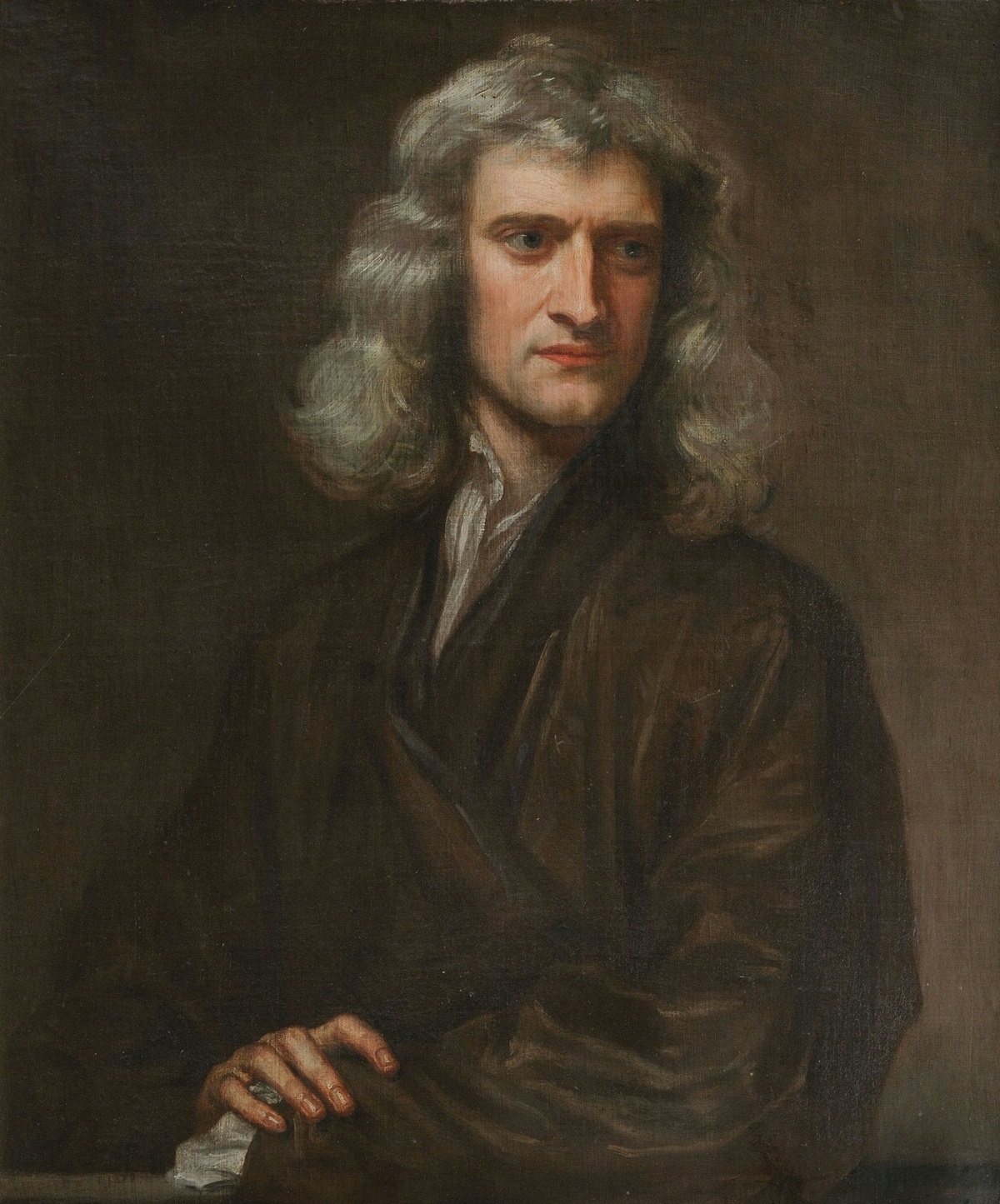
Isaac Newton was an English mathematician, physicist, astronomer, alchemist, theologian, and author (described in his time as a "natural philosopher"), widely recognised as one of the greatest mathematicians and physicists and among the most influential scientists of all time. He was a key figure in the philosophical revolution known as the Enlightenment. His book Philosophiæ Naturalis Principia Mathematica (Mathematical Principles of Natural Philosophy), first published in 1687, established classical mechanics. Newton also made seminal contributions to optics, and shares credit with German mathematician Gottfried Wilhelm Leibniz for developing infinitesimal calculus.
In the Principia, Newton formulated the laws of motion and universal gravitation that formed the dominant scientific viewpoint until it was superseded by the theory of relativity. Newton used his mathematical description of gravity to derive Kepler's laws of planetary motion, account for tides, the trajectories of comets, the precession of the equinoxes and other phenomena, eradicating doubt about the Solar System's heliocentricity. He demonstrated that the motion of objects on Earth and celestial bodies could be accounted for by the same principles. Newton's inference that the Earth is an oblate spheroid was later confirmed by the geodetic measurements of Maupertuis, La Condamine, and others, convincing most European scientists of the superiority of Newtonian mechanics over earlier systems.



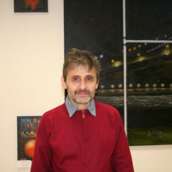
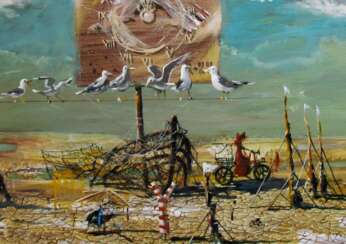






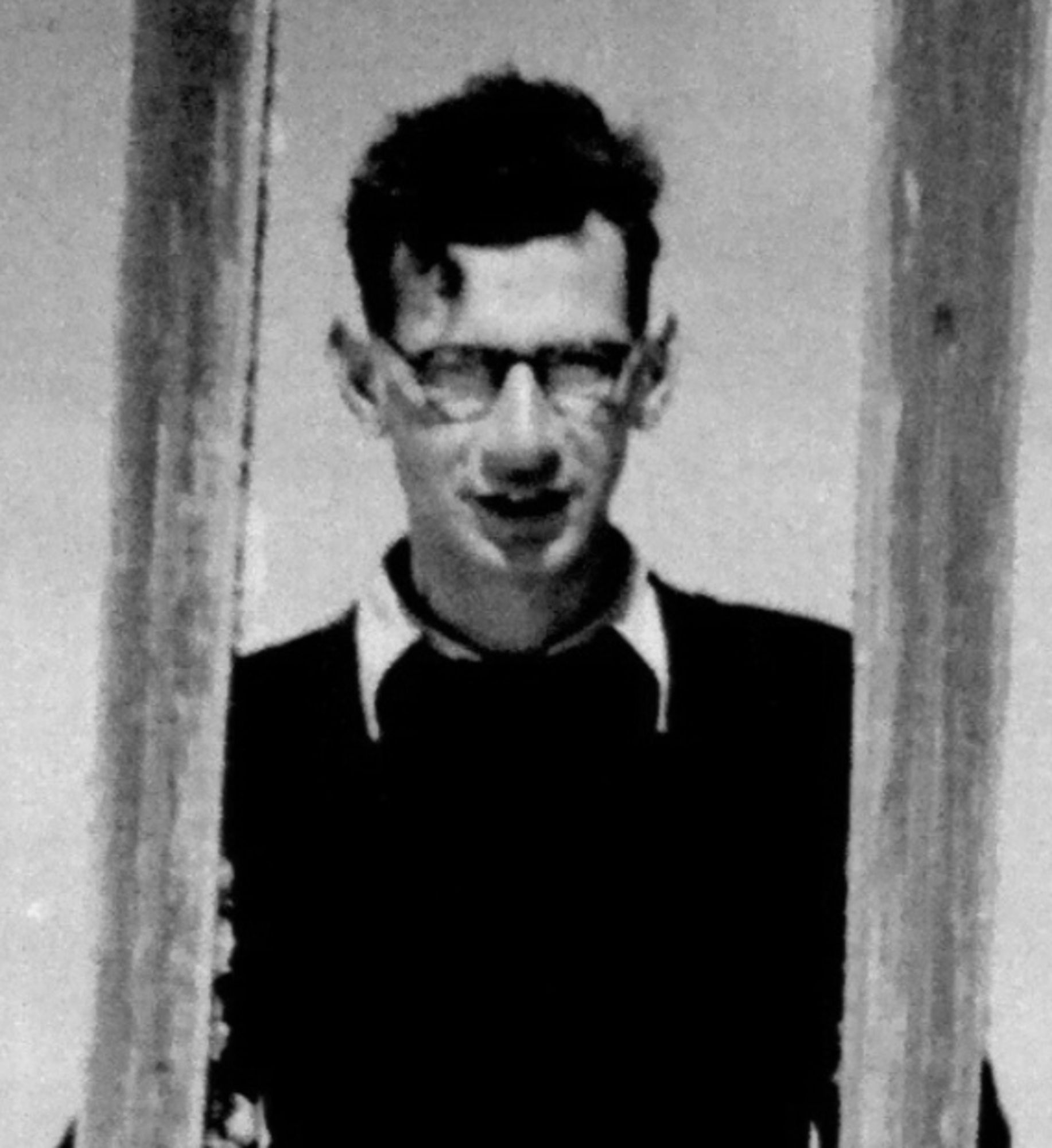
Rudolf Grossmann (German: Rudolf Grossmann, or Großmann), full name Rudolf Wilhelm Walther Grossmann, was a German painter, draftsman, illustrator and graphic artist.
Born into an artistic family, Grossmann began his education in painting and printmaking at the Düsseldorf Academy before continuing his studies in Paris with Lucien Simon and Pouleroz. Among his best-known works are various portrait drawings of celebrities, notably those published in the satirical periodical Simplicissimus; he was also known for his book illustrations. Grossmann began publishing his prints in 1905, and many major publishers in Germany and France commissioned his work. He later concentrated on figurative works and urban scenes, which showed the influence of Cézanne and Pasquin.
From 1928 until Hitler's Nazi Party came to power, Grossmann taught at the Berlin Royal School of Art and was a member of the Berlin Secession and the Deutsche Kunstlerbund. In 1934, his work, like that of many of his colleagues, was stigmatized as degenerate and confiscated by the Nazi government, and he was disbarred from practicing his profession. He soon left for Freiberg im Beisgau, where he died on November 28, 1941.

Rudolf Grossmann (German: Rudolf Grossmann, or Großmann), full name Rudolf Wilhelm Walther Grossmann, was a German painter, draftsman, illustrator and graphic artist.
Born into an artistic family, Grossmann began his education in painting and printmaking at the Düsseldorf Academy before continuing his studies in Paris with Lucien Simon and Pouleroz. Among his best-known works are various portrait drawings of celebrities, notably those published in the satirical periodical Simplicissimus; he was also known for his book illustrations. Grossmann began publishing his prints in 1905, and many major publishers in Germany and France commissioned his work. He later concentrated on figurative works and urban scenes, which showed the influence of Cézanne and Pasquin.
From 1928 until Hitler's Nazi Party came to power, Grossmann taught at the Berlin Royal School of Art and was a member of the Berlin Secession and the Deutsche Kunstlerbund. In 1934, his work, like that of many of his colleagues, was stigmatized as degenerate and confiscated by the Nazi government, and he was disbarred from practicing his profession. He soon left for Freiberg im Beisgau, where he died on November 28, 1941.