

Doctors
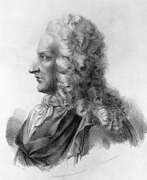

Antonio Vallisneri the Elder was an Italian naturalist, physician and geologist, collector, and member of the Royal Society of London.
He studied in Bologna, Venice, Padua and Parma and headed the chair first of practical medicine and then of theoretical medicine at the University of Padua. In addition to medicine, Vallisneri conducted important research in the natural sciences. In particular, in the field of geology, he is credited with recognizing the organic nature of fossils unrelated to the Great Flood, which contributed to the end of centuries-old disputes. His observations on the water cycle, thermal waters and some mines in the Apennines were also important.
Vallisneri was interested in all branches of the natural sciences, collecting numerous collections of animals, minerals, and other natural objects during his lifetime. The scientist compiled a brief catalog of his collection, which was published in 1733 by his son, Antonio Vallisneri, Jr. The Vallisneri Museum included naturalistic finds, anatomical preparations, medical and scientific instruments, antiques, and exotics from various cultures and eras as well as geographical origins. In 1734, his son donated this museum to the University of Padua, initiating the creation of a general museum for the university.
Antonio Vallisneri Jr. followed in his father's footsteps and for many years held the position of professor of natural history at the University of Padua. He devoted his life to collecting and processing his father's writings and tidying up his library, which contained about a thousand volumes. These were donated to the University Library in Padua.
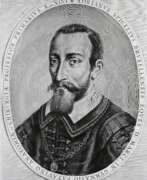

Adriaan van den Spiegel (or Spieghel), name sometimes written as Adrianus Spigelius, was a Flemish anatomist born in Brussels. For much of his career he practiced medicine in Padua, and is considered one of the great physicians associated with the city. At Padua he studied anatomy under Girolamo Fabrici.
His best written work on anatomy is De humani corporis fabrica libri X tabulis aere icisis exornati, published posthumously in 1627. In his 1624 treatise De semitertiana libri quatuor, he gave the first comprehensive description of malaria.
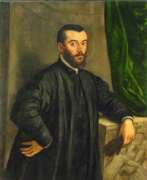

Andreas Vesalius (Dutch: Andries van Wesel) was a Flemish physician, one of the first anatomists of the Renaissance.
Vesalius came from a family of physicians and apothecaries, studied at the Catholic University of Leuven and at the medical school of the University of Paris, where he learned to dissect animals. He also had the opportunity to dissect human cadavers and devoted much time to the study of human bones. He later went to the University of Padua and, after earning his MD degree, was appointed professor of surgery, whose duties included anatomical demonstrations.
Vesalius revolutionized the study of biology and medical practice through his careful description of the anatomy of the human body. Based on observations made by himself, he wrote and illustrated the first complete textbook of anatomy. In 1543 his major work De humani corporis fabrica libri septem ("Seven Books on the Structure of the Human Body"), commonly known as Fabrica, was printed. In this epochal work, Vesalius gave far more extensive and accurate descriptions of the human body than anything that had been done by his predecessors.
In the same year, 1543, the Holy Roman Emperor Charles V appointed him staff physician of his house, and in 1559 Vesalius became physician to the Madrid court of Charles V's son, Philip II.
Vesalius' work made anatomy a scientific discipline with far-reaching implications not only for physiology but for all of biology.
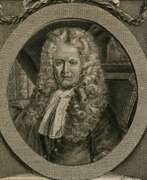

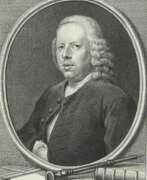

Johannes Eusebius Voet was a Dutch physician, poet, entomologist and illustrator.
Voet worked as a physician in Dordrecht and had a large collection of insects and shells. Studying beetles and other insects, he wrote Catalogus Systematicus Coleopterorum, Systematische naamlijst van dat geslacht der Insecten dat men Torren noemt, which was published in 1804-1806. It was one of the best entomological works published in the Netherlands. It contained numerous original hand-colored engravings, many of them by C.F.C. Kleemann, Rösel's son-in-law.
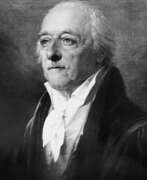

Nikolaus von Jacquin, full name Nikolaus Joseph Freiherr von Jacquin, also Baron Nikolaus von Jacquin, was an Austrian and Dutch scientist, professor of chemistry and botany, and director of the Vienna Botanical Garden.
Jacquin is considered a pioneer of scientific botany in Austria. He wrote fundamental works in botany, was the first to describe many plants, fungi, and animals, introduced experimental methods in chemistry, and successfully campaigned for the introduction of Linnaeus' system of plants in Austria. On behalf of Emperor Franz I, von Jacquin was in charge of the imperial gardens (including Schoenbrunn) and also led a scientific expedition to Central America from 1754 to 1759, from which he returned with an extensive collection of plants.
In 1768, Nikolaus von Jacquin was appointed professor of botany and chemistry at the Faculty of Medicine of the University of Vienna and director of the newly founded botanical garden, which he reorganized according to scientific principles. Nikolaus von Jacquin was a member of the Royal Society of London, a foreign honorary member of the St. Petersburg Academy of Sciences, and a correspondent of the Paris Academy of Sciences.

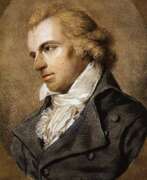

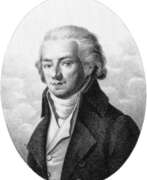

Samuel Thomas von Soemmering was a German physician, anatomist, anthropologist, paleontologist, physiologist and inventor.
He studied medicine at Göttingen, where he received his doctorate, and in the same year became professor of anatomy at Kassel, then at Mainz. Among Soemmering's contributions to biology are the discovery of the macula in the retina of the human eye, studies of the brain, lungs, nervous system, and embryonic malformations, and he published many papers in the fields of neuroanatomy, anthropology, and paleontology. He was the first to give a reasonably accurate account of the structure of the female skeleton.
Soemmering also worked on fossil crocodiles and pterodactyls, which at the time were called ornithocephalians. In addition, Soemmering dabbled in chemistry, astronomy, philosophy, and various other fields of science. Among other things, he investigated the refinement of wines and sunspots, and designed a telescope for astronomical observations. In 1809, Soemmering developed a sophisticated telegraph system based on electrochemical current, which is now preserved in the German Science Museum in Munich.