medicine & science
![[REMÈDES & RECETTES].](/assets/image/picture_2734777/85e13/39559a247a08aa235a6ad5af380707d51679526000jpg__fix_374_244.jpeg)
![[REMÈDES & RECETTES].](https://veryimportantlot.com/assets/image/picture_2734777/85e13/39559a247a08aa235a6ad5af380707d51679526000jpg__fix_374_244.jpeg)

![[BOYLE, Robert (1627-1691)]](/assets/image/picture_5109430/040d0/e6224dadc2eec368f482335111b1e33b1765321200jpg__fix_374_244.jpeg)
![[BOYLE, Robert (1627-1691)]](https://veryimportantlot.com/assets/image/picture_5109430/040d0/e6224dadc2eec368f482335111b1e33b1765321200jpg__fix_374_244.jpeg)
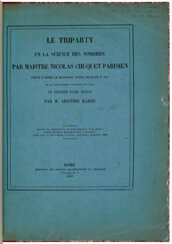

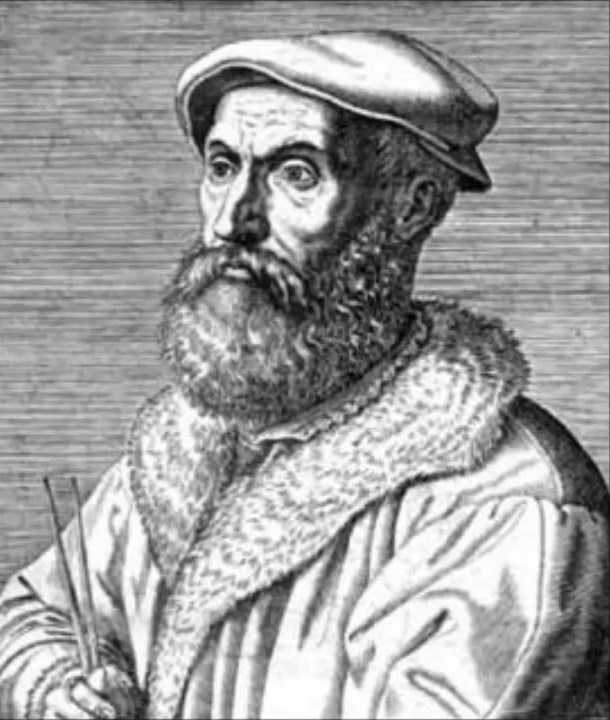
Nicolas Chuquet was a 15th century French mathematician.
The exact dates of birth and death of this scientist are not known, nor are the places of birth. Chuquet received a Bachelor of Medicine degree from the University of Paris, went to Italy in the early 1470s, and around 1480 moved to Lyon, where he worked as a physician, mathematics teacher, and scribe. He is also known to have translated Latin works into French.
In 1484 he wrote his major algebraic work, the treatise Le Triparty en la Science des Nombres (The Science of Numbers in Three Parts), now considered one of the most original mathematical texts of the 15th century. At the time, arithmeticians lacked even the most basic notations for addition subtraction, multiplication, and division. Chuquet was one of the first to propose these symbols; he also introduced the names of large numbers into common use: billion, trillion, etc. In addition to general arithmetic and rules for calculating roots, the treatise contains a doctrine of equations and a collection of problems.
This treatise was published only in 1880, but the works of Nicolas Chuquet had a significant influence on the development of algebra, and they were consistently supplemented and expanded by scientists of the following generations.

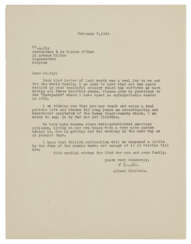

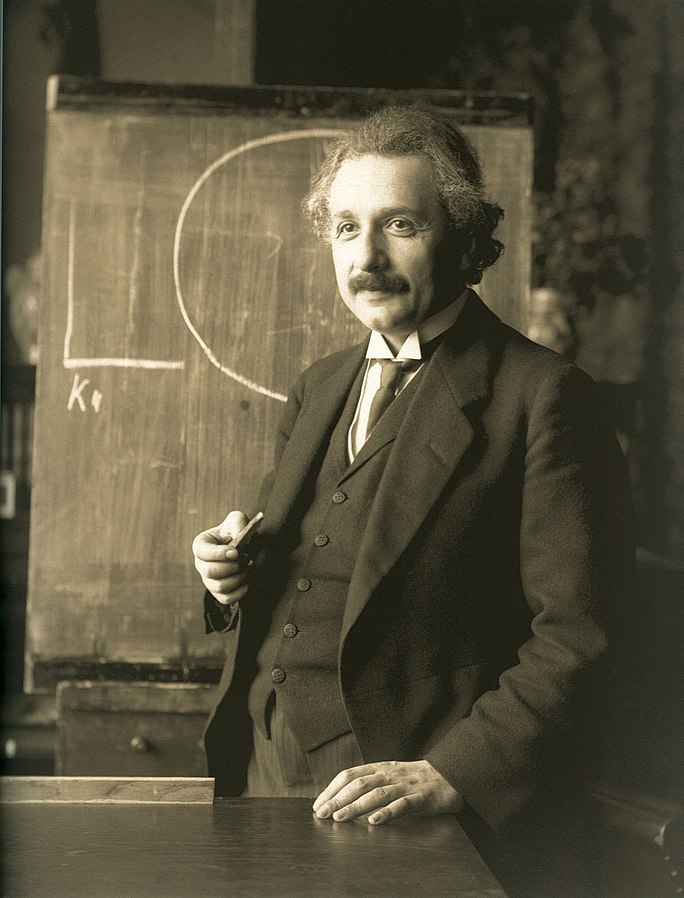
Albert Einstein was a German-born theoretical physicist, widely acknowledged to be one of the greatest and most influential physicists of all time. Einstein is best known for developing the theory of relativity, but he also made important contributions to the development of the theory of quantum mechanics. Relativity and quantum mechanics are together the two pillars of modern physics. His mass–energy equivalence formula E = mc2, which arises from relativity theory, has been dubbed "the world's most famous equation". His work is also known for its influence on the philosophy of science. He received the 1921 Nobel Prize in Physics "for his services to theoretical physics, and especially for his discovery of the law of the photoelectric effect", a pivotal step in the development of quantum theory. His intellectual achievements and originality resulted in "Einstein" becoming synonymous with "genius".
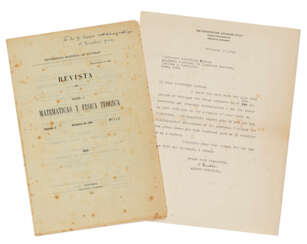

Albert Einstein was a German-born theoretical physicist, widely acknowledged to be one of the greatest and most influential physicists of all time. Einstein is best known for developing the theory of relativity, but he also made important contributions to the development of the theory of quantum mechanics. Relativity and quantum mechanics are together the two pillars of modern physics. His mass–energy equivalence formula E = mc2, which arises from relativity theory, has been dubbed "the world's most famous equation". His work is also known for its influence on the philosophy of science. He received the 1921 Nobel Prize in Physics "for his services to theoretical physics, and especially for his discovery of the law of the photoelectric effect", a pivotal step in the development of quantum theory. His intellectual achievements and originality resulted in "Einstein" becoming synonymous with "genius".


![[HERBAL]](/assets/image/picture_5108883/1dd2b/c148090935abcdf46909d404a61555bd1765321200jpg__fix_374_244.jpeg)
![[HERBAL]](https://veryimportantlot.com/assets/image/picture_5108883/1dd2b/c148090935abcdf46909d404a61555bd1765321200jpg__fix_374_244.jpeg)

















![[GALILEO GALILEI (1564-1642) and Girolamo SPINELLI (c.1580-1647)]](/assets/image/picture_4734998/a317b/b78ba02793ea9f7c89bc2421c803edfc1752012000jpg__fix_374_244.jpeg)
![[GALILEO GALILEI (1564-1642) and Girolamo SPINELLI (c.1580-1647)]](https://veryimportantlot.com/assets/image/picture_4734998/a317b/b78ba02793ea9f7c89bc2421c803edfc1752012000jpg__fix_374_244.jpeg)
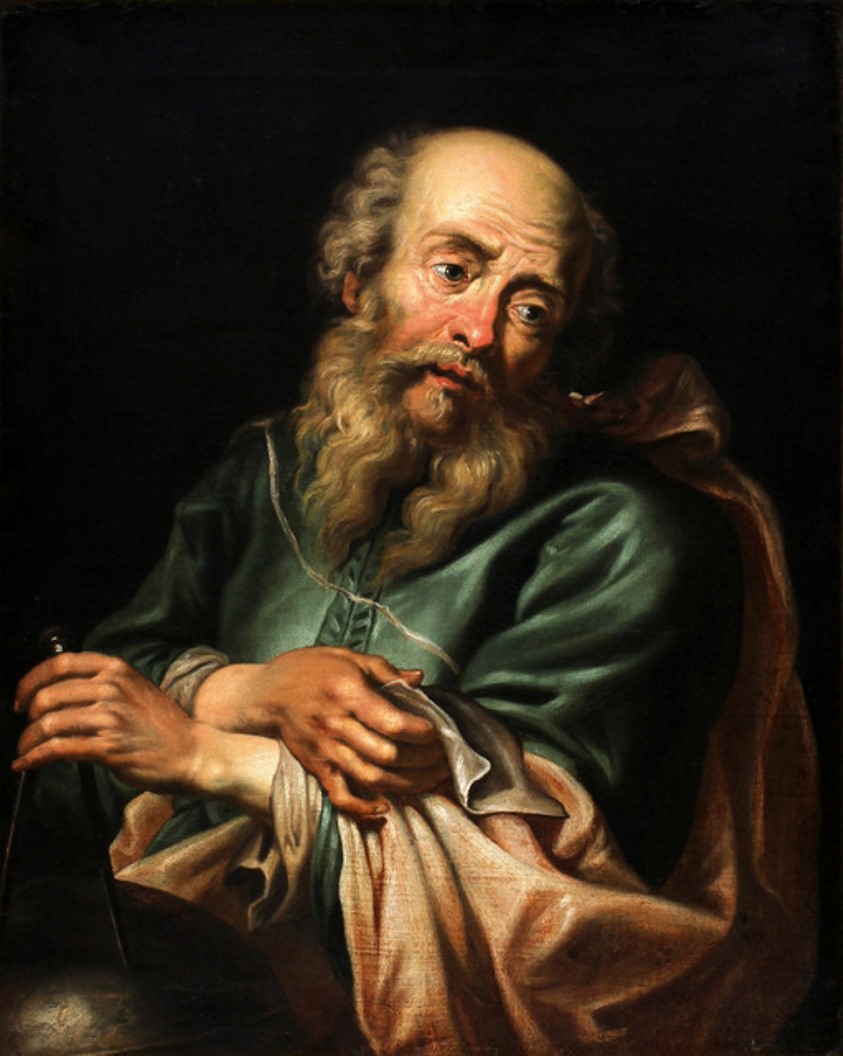
Galileo Galilei was an Italian naturalist, physicist, mechanic, astronomer, philosopher, and mathematician.
Using his own improved telescopes, Galileo Galilei observed the movements of the Moon, Earth's satellites, and the stars, making several breakthrough discoveries in astronomy. He was the first to see craters on the Moon, discovered sunspots and the rings of Saturn, and traced the phases of Venus. Galileo was a consistent and convinced supporter of the teachings of Copernicus and the heliocentric system of the world, for which he was subjected to the trial of the Inquisition.
Galileo is considered the founder of experimental and theoretical physics. He is also one of the founders of the principle of relativity in classical mechanics. Overall, the scientist had such a significant impact on the science of his time that he cannot be overemphasized.



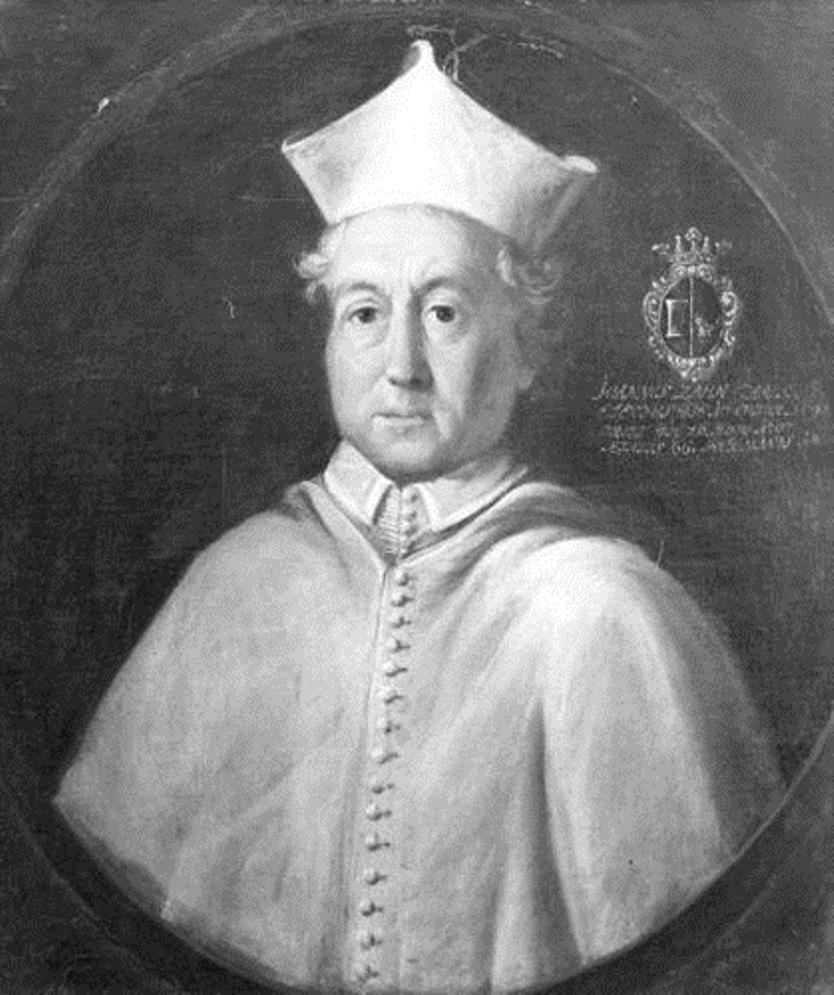
Johann Zahn (German: Johann or Johannes Zahn) was a German scientist and philosopher, optician and astronomer, mathematician and inventor.
Zahn studied mathematics and physics at the University of Würzburg, was professor of mathematics at the University of Würzburg, and served as a canon of the Order of Regular Canon Premonstratensians. His other activities were optics as well as astronomical observations.
In 1686 Johann Zahn invented and designed a portable camera obscura with fixed lenses and an adjustable mirror, which is the prototype of the camera. In his treatise on optics, Oculus Artificialis Teledioptricus (1702), Zahn gives a complete picture of the state of optical science of his time. He begins with basic information about the eye and then moves on to optical instruments. The book is aimed at eighteenth-century microscope and telescope enthusiasts and includes all the necessary details of construction, from lens grinding to drawings.