Landscape painters German Expressionism
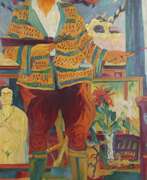

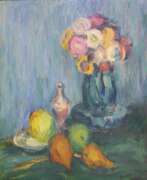

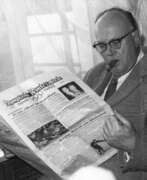

Franz Bronstert was a German engineer and painter. Before World War I Bronstert visited and finished the superior school for engineers in Hagen. He served during the war in the rank of Lieutenant and later „Rittmeister" equivalent to Captain. As a prisoner of war at Ripon, Yorkshire he got into contact with artists Fritz Fuhrken and Georg Philipp Wörlen and started with his own artistic work. These contacts led to the foundation of the group of artists „Der Fels" (The Rock). Past the war he settled in Hagen and made contact with the group around collector Karl Ernst Osthaus especially with Christian Rohlfs. The latter influenced the work of Bronstert considerably. Membership in „Der Fels" led to numerous exhibitions all over Germany and Austria between 1921 and 1927. Bronstert’s art developed from radical expressionism of the early twenties to a realistic phase and finally to a reformed impressionism as the artist claims himself. Bronstert finds his motifs mostly in nature. Even though Bronstert mastered several techniques, like oil painting, drawing, woodcut it was the watercolour painting that he loved most. Bronstert was both a technical and artistic talent. He was successful in his job and was a member of the board of VARTA with several international patents on his record when he retired. Past retirement he concentrated solely on his art again. Works by Bronstert can be found in the Schneider Collection, Museum Baden, Solingen; in the collections of Karl Ernst Osthaus-Museum in Hagen; in the Museum Schloss Moyland, in the Von der Heydt-Museum, Wuppertal, in the Bavarian State Painting Collections, Munich,and in the art museums of Soest, Germany, Iserlohn, and Lüdenscheid as well as in private collections.


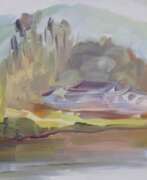


Friedrich Karl Gotsch, actually Friedrich Karl Müller, was a German painter and graphic artist.
After a phase of intense research into Picasso's cubism and experimentation with abstract techniques, the artist developed "late expressionism", which was typical of his work. Even during his lifetime, Gotsch was highly respected as one of the few painters of his generation who painted representational pictures. He also participated in numerous exhibitions and received renowned awards.
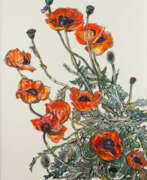

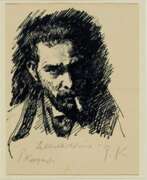

Paul Kayser was a German painter and graphic artist. After training as a painter-decorator, Kayser attended the Schools of Applied Art in Munich and Dresden.
Paul Kayser was a founding member of the Hamburg Artists' Club 1897 and the Hamburg Secession, and a member of the Hamburg Artists' Association and the Altona Artists' Association. His style was decisively influenced by Albert Marquet, whom Kaiser met in 1909.
In 1937, Kaiser's still life was confiscated from the museum in Husum as part of the Nazi "Degenerate Art" campaign.
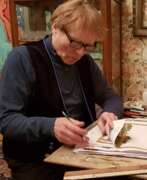

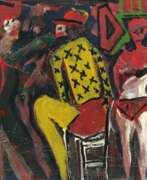

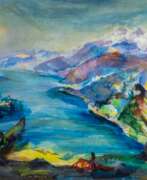


Lisel Oppel, actually Anna Amalie Elisabeth Oppel, was a German painter and ceramist who remains to this day one of the most memorable members of the Worpswede artist colony. From 1917 she studied painting at the Academy of Fine Arts in Munich with Richard Riemerschmid and Hermann Gröber.
Liesel Oppel painted simple paintings with great joy and colourfulness; mainly portraits, people at work and on holidays, less often pure landscapes. One of Oppel's special pictorial themes was children's pastimes in the countryside, in which she adopted and extended the motifs of the early Worpswede artists. Most of her work was created in the 1950s. She continued her expressive painting style.


Siegward Sprotte was a German artist, writer and philosopher.
Originally Siegward Sprotte painted figuratively, including portraits of old masters and drawings. Later he devoted himself more to landscape, up to the ideogram and colourful calligraphy.
Sprotte has written many works on the subjects of art, consciousness and modernity, and is the creator of a new paradigm of "eye-to-eye".
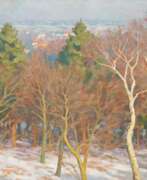

Walter Tanck was a German landscape painter, engraver and woodcarver. He studied painting with Franz Nölken in Hamburg.
In 1937, as part of the Nazi "Degenerate Art" campaign, his graphic portfolio "Don Quixote" (15 etchings and a lithograph on the title page) from the Dusseldorf Art Collection and his panel "Nude Woman" were confiscated and destroyed.