

Portraitist Impressionism


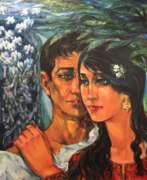

Tamam Al-Akhal is a Palestinian artist and educator living in Jordan. She studied at the Fine Arts College in Cairo. From 1957 to 1960, she taught art at the Makassed Girls College in Beirut. In 1959, she married Ismail Shammout. Al-Akhal has exhibited in Egypt, Lebanon, Jerusalem, Jordan, the United States, Kuwait, England, China, Morocco, Berlin, Paris, Rome, and Vienna. She gave a series of lectures at the Jordan National Gallery of Fine Arts in 2009. Her art appeared on more than a dozen covers of Palestinian Affairs, a magazine published by the Palestine Liberation Organization. She was also head of the PLO's Arts and Heritage section. With her husband, she painted a series of large murals known as "Palestine: The Exodus and the Odyssey."
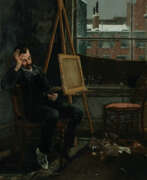

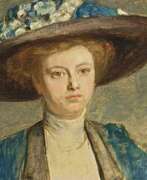

August Allebé was an artist and teacher from the Northern Netherlands. His early paintings were in a romantic style, but in his later work he was an exponent of realism and impressionism. He was a major initiator and promoter of Amsterdam Impressionism, the artist's association St. Lucas, and the movement of the Amsterdamse Joffers. Amsterdam Impressionism – sometimes referred to by art historians as the School of Allebé – was the counterflow to the very strong Hague School in the movement of Dutch Impressionism. As a professor at the Royal Academy of Amsterdam (Rijksakademie van beeldende kunsten) he fostered a cosmopolitan attitude toward art and the promotion and motivation of his students, and provided a significant stimulus to developments in modern art.
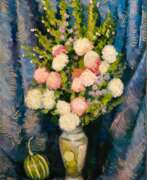

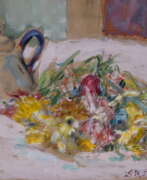

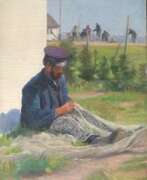

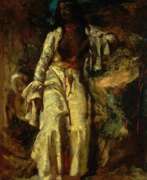

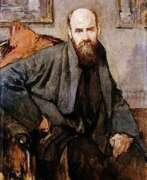

Albert Baertsoen was a Belgian painter, pastellist and graphic artist. His debut as a painter came in 1887, when he participated in an exhibition in Brussels held by the secessionist group l'Essor. He continued his studies in Paris, at the art school of Alfred Philippe Roll, and exhibited at the Salon in 1889. In 1894, he helped found the "Cercle des Beaux-Arts d'Ostende". From 1896 to 1901, he continued to exhibit throughout Europe, winning several Gold Medals. In 1913, he served as a member of the art jury for the Ghent World's Fair. During World War I, he lived in London, returning to Ghent in 1919. That same year, he was appointed a member of the Royal Academy of Belgium.
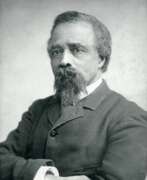

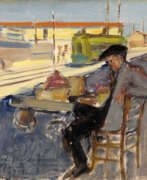

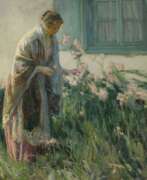

Myron G. Barlow was an American painter and illustrator known for his genre scenes, portraits, and landscapes. He was began his artistic training at the Art Institute of Chicago. Later, he studied at the Académie Julian in Paris, where he was influenced by the Impressionist and Post-Impressionist movements.
Barlow worked as an illustrator for various publications, including Harper's Weekly, Scribner's Magazine, and The Saturday Evening Post. He also taught at the Art Students League in New York City.
Barlow's paintings often depicted everyday life, with a focus on working-class people and their surroundings. His use of color and light gave his paintings a sense of warmth and intimacy.
Barlow was a member of several art organizations, including the National Academy of Design, the Society of American Artists, and the American Watercolor Society. He received numerous awards and honors during his lifetime, including a gold medal at the Panama-Pacific International Exposition in San Francisco in 1915.
Today, his paintings can be found in several museums and institutions, including the National Gallery of Art in Washington, D.C., and the Brooklyn Museum in New York City.
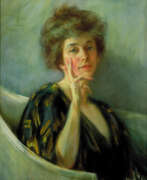


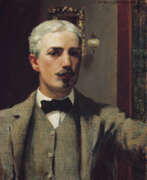

James Carroll Beckwith was an American landscape, portrait and genre painter whose Naturalist style led to his recognition in the late nineteenth and very early twentieth century as a respected figure in American art.
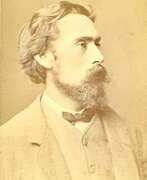

Adalbert Franz Eugene Begas is a German painter and portrait painter. In 1862, Adalbert followed his brother, the sculptor Reinhold, to the Grand Ducal Saxon School of Art in Weimar, where he began working in the workshop of Arnold Böcklin.
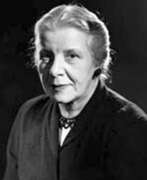

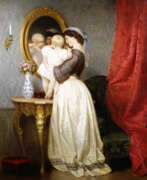

Robert Beyschlag was a German painter of the 19th century. He is known as a painter, famous for his paintings of mythological subjects and portraits of women.
Beyschlag early in his career created genre paintings depicting the medieval era, but later turned his attention to mythology, a prime example of which is the oft-repeated depiction of Psyche in his works. Inspired by Romanticism, the artist also created pastoral subjects with peasant women and shepherdesses. His work was characterized by optimism, theatricalization and idealization of characters, as well as rich colorism. He also created frescoes for the Bavarian National Museum in Munich, depicting scenes from the history of the Crusades.


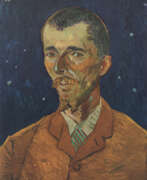

Eugène Boch was a Belgian painter, celebrated for his vibrant contributions to the Post-Impressionist movement. Boch was part of a prominent family known for their fine china business, Villeroy & Boch. He pursued his passion for art in Paris, studying under notable teachers such as Léon Bonnat and Fernand Cormon.
Eugène Boch's artistry is marked by his distinct style and use of color, which earned him spots in prestigious exhibitions like the Salon in Paris during the 1880s. His works, characterized by their emotional depth and innovative techniques, reflect the bold spirit of the Post-Impressionist era. He was not only a painter but also a visionary, whose works resonated with the aesthetic shifts of his time.
One of Eugène Boch's most notable associations was with Vincent van Gogh, who painted Boch in the famous portrait "The Poet," which Van Gogh described as a vision of idealistic and artistic purity. This painting is now housed at the Musée d'Orsay, symbolizing their profound connection and mutual respect. Boch's own works, like "The Red Roofs," demonstrate his unique ability to blend reality with his visionary outlook, showcasing scenes filled with vivid colors and dynamic compositions.
Eugène Boch's legacy extends beyond his paintings. Upon his death in 1941, he left a significant impact on the cultural heritage of Europe, influencing future generations of artists. His works continue to be celebrated in major museums and galleries, reminding us of his pivotal role in the development of modern art.
For collectors and experts in art and antiques, Boch's works offer a timeless exploration of Post-Impressionist vibrancy. Sign up for updates and stay informed about new sales and auction events featuring Eugène Boch’s timeless works, ensuring you never miss an opportunity to own a piece of art history.
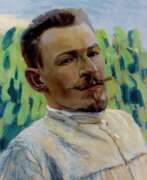

Victor Elpidiforovich Borisov-Musatov (Russian: Ви́ктор Эльпидифо́рович Бори́сов-Муса́тов) was a distinguished Russian artist celebrated for his unique contribution to the Post-Impressionist movement, combining elements of Symbolism, realism, and a decorative style that was all his own. Born in 1870 in Saratov, Russia, into the family of a former serf, Borisov-Musatov overcame early challenges, including a spinal injury that left him humpbacked, to emerge as a pivotal figure in Russian art. His education spanned the Moscow School of Painting, Sculpture and Architecture, and the Imperial Academy of Arts in Saint-Petersburg, further enriched by studies in Paris under the tutelage of Fernand Cormon. His admiration for French contemporaries, especially Pierre Puvis de Chavannes and Berthe Morisot, profoundly influenced his artistic direction.
Borisov-Musatov is renowned for his lyrical, evocative works that often depict the serene and idyllic life of the 19th-century Russian nobility, set against the backdrop of their estates. This half-illusory world, which he masterfully created, reflects a deep nostalgia and a retreat from the industrial harshness of his time. By integrating figures seamlessly into the landscapes, as seen in masterpieces like "The Pool" (1902) and "The Phantoms" (1903), he achieved a harmony that resonates with viewers for its beauty and tranquility. His use of mixed media, including tempera, watercolor, and pastel, allowed for subtle visual effects, making his works distinctive in their soft, dreamlike quality.
Borisov-Musatov's legacy extends beyond his paintings; he was a significant figure in the Russian Symbolist movement and a founding member of the Moscow Association of Artists. His works, which provide a poignant, poetic commentary on the era he lived in, are celebrated in Russian and international art circles alike. Notable paintings like "The Pool" and "The Phantoms" not only highlight his technical skill but also his ability to evoke emotion and atmosphere, making them favorites among collectors and art enthusiasts.
For collectors and experts in art and antiques, Borisov-Musatov's oeuvre offers a fascinating glimpse into the Russian Symbolist movement and the broader cultural milieu of the late 19th and early 20th centuries. His works, preserved in museums and private collections around the world, continue to enchant and inspire.
For those interested in staying informed about new product sales and auction events related to Victor Elpidiforovich Borisov-Musatov, subscribing for updates is highly recommended. This subscription ensures that enthusiasts and collectors alike will not miss the opportunity to own a piece of this remarkable artist's legacy, encapsulating the elegance and serenity that define his work.
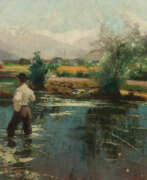


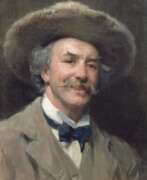

Frank Bramley was an English post-impressionist genre painter of the Newlyn School. Bramley studied at the Lincoln School of Art. He then studied at the Royal Academy of Fine Arts in Antwerp. He lived in Venice from 1882 to 1884 and then moved to Cornwall and established himself in the Newlyn School artist colony on Rue des Beaux Arts. Along with Walter Langley and Stanhope Forbes, he was considered to be one of the "leading figures" of the Newlyn School. In contrast to other members of the Newlyn school, Bramley specialised in interiors and worked on combining natural and artificial light in his paintings, such as A Hopeless Dawn. During his time in Newlyn, Bramley was a particular exponent of the ‘square brush technique’, using the flat of a square brush to lay the paint on the canvas in a jigsaw pattern of brush strokes, giving a particular vibrancy to the paint surface. In the early 1890s, his palette became brighter and his handling of the paint looser and more impastoed, while his subject matter narrowed to portraits and rural genre paintings. In 1894 Bramley became an Associate of the Royal Academy (ARA) and in 1911 he became a Royal Academician (RA). He was also a gold medal winner at the Paris Salon.
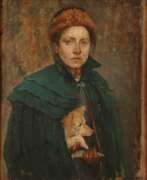


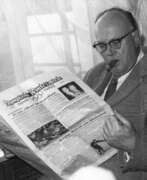

Franz Bronstert was a German engineer and painter. Before World War I Bronstert visited and finished the superior school for engineers in Hagen. He served during the war in the rank of Lieutenant and later „Rittmeister" equivalent to Captain. As a prisoner of war at Ripon, Yorkshire he got into contact with artists Fritz Fuhrken and Georg Philipp Wörlen and started with his own artistic work. These contacts led to the foundation of the group of artists „Der Fels" (The Rock). Past the war he settled in Hagen and made contact with the group around collector Karl Ernst Osthaus especially with Christian Rohlfs. The latter influenced the work of Bronstert considerably. Membership in „Der Fels" led to numerous exhibitions all over Germany and Austria between 1921 and 1927. Bronstert’s art developed from radical expressionism of the early twenties to a realistic phase and finally to a reformed impressionism as the artist claims himself. Bronstert finds his motifs mostly in nature. Even though Bronstert mastered several techniques, like oil painting, drawing, woodcut it was the watercolour painting that he loved most. Bronstert was both a technical and artistic talent. He was successful in his job and was a member of the board of VARTA with several international patents on his record when he retired. Past retirement he concentrated solely on his art again. Works by Bronstert can be found in the Schneider Collection, Museum Baden, Solingen; in the collections of Karl Ernst Osthaus-Museum in Hagen; in the Museum Schloss Moyland, in the Von der Heydt-Museum, Wuppertal, in the Bavarian State Painting Collections, Munich,and in the art museums of Soest, Germany, Iserlohn, and Lüdenscheid as well as in private collections.


Fyodor Fyodorovich Buchholz (Russian: Фёдор Фёдорович Бухгольц) was a Russian artist of German origin in the late 19th century and the first half of the 20th century. He is known as a painter, graphic artist and teacher.
Fyodor Buchholz painted mainly on historical themes and genre paintings, as well as portraits and landscapes. At the end of the XIX century, the artist was fascinated by Art Nouveau. After the revolution of 1917 he began to create works on the themes of social construction.
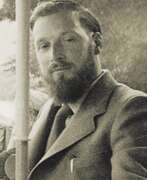

Lionel Victor Bulmer was an English impressionist painter, a member of the New English Art Club, founded in 1886 as an exhibition society dedicated to promoting the avant-garde technique of French impressionist painting, the influence of which was clearly evident in Bulmer's own work.


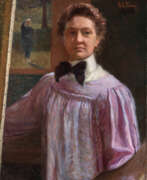

Lilla Cabot Perry, birth name Lydia Cabot Perry, is an American impressionist painter.
Lydia Cabot Perry began painting after her marriage and the birth of her children. Some time spent in Japan and France, where she painted a lot. After meeting Claude Monet, which took place in 1894, the artist sharply changes his style and technique of image. Among other genres, she favoured landscape painting.
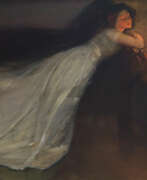

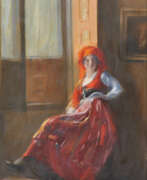


Jacques (Ya'akov) Chapiro was a painter of the School of Paris.
Chapiro's works can be found in museums in the United States (Chicago), Russia (Moscow) and France (Jeu de Paume, Paris). As to his artistic style, it seems that Chapiro was fond of experiments. His many paintings are much different from one another; some are classified as Cubistic in style, some as Impressionist and others as Fauvist. Throughout his artistic career, Chapiro kept sketching in his unique signature, with a light and talented hand. It is in his realistic sketching, which are somewhat casual, that one can be truly impressed by his talent.
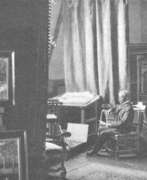

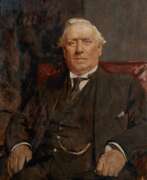

André Edmond Alfred Cluysenaar was a Belgian painter. He was especially known for portraits and female figures. He was member of the Cluysenaar family, descendant from a long line of architects who originated in Aachen. He received his first art lessons from his father, then studied with François-Joseph Navez. Initially, he worked as a sculptor, but devoted himself entirely to painting after 1902. He was firmly grounded in the romantic style at first; producing still lifes and genre scenes, but later turned to impressionism and painted mostly female figures, often semi-nude. He also executed monumental ceiling paintings for the City Hall in Saint-Gilles. During World War I, he lived in London where he established a reputation painting portraits of notable people, including the Royal Family, which were done in a more commercial style using Alfred Stevens as a model. Most of these portraits may be seen in the National Gallery.


Charles Edward Conder, an Anglo-British painter, was a pivotal figure in the Australian art scene, known for his significant contributions to the Heidelberg School and the famous 9 x 5 Impressions Exhibition. Born in England in 1868, Conder's artistic journey began in earnest when he moved to Australia, where he immersed himself in the country's landscapes and developed a unique style that melded his natural instinct for color and design with the influences of his contemporaries and the environment.
Charles Edward Conder's time in Australia was marked by collaborative efforts with other notable artists, including Tom Roberts and Arthur Streeton, with whom he shared a studio and participated in the notable 9 x 5 Impressions Exhibition. His work during this period, characterized by a distinctive use of color and form, captured the essence of the Australian landscape while reflecting his personal artistic sensibilities.
In 1890, Charles Edward Conder's artistic pursuits took him to Europe, where he studied in Paris and mingled with prominent artists and writers of the day. His work continued to evolve, embracing the influences of Aestheticism and the Bohemian lifestyle he led. Despite his artistic success, Conder's life was marred by health issues, including the effects of syphilis, which he contracted early in his career. His later years were spent in a struggle with the disease, culminating in his death in a sanatorium in 1909.
Today, Conder's legacy is preserved in his contributions to Australian art and the influence he had on his peers and successors. His works continue to be celebrated for their beauty, emotional depth, and the unique perspective they provide on the landscapes and culture of Australia during his time.
For those interested in delving deeper into the life and works of Charles Edward Conder, his art remains a testament to his skill and vision, offering a window into the vibrant art scene of his era and the landscapes that inspired him.
If you're captivated by the unique blend of Australian landscapes and European artistry in Charles Edward Conder's work, or if you wish to discover more about the Heidelberg School's influence on art and culture, we invite you to sign up for updates. Stay informed about upcoming exhibitions, sales of Conder's works, and exclusive insights into the world of art collecting. Don't miss the opportunity to deepen your appreciation for one of the luminaries of Australian art.
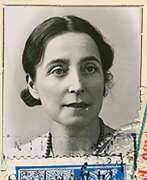

Margherita known as Mara Corradini was an Italian painter and illustrator. Daughter of an industrialist, she studied in Naples, Munich, at the Académie Julian in Paris, in Berlin as a pupil of Martin Brandenburg and then of Henry Luyten at the Institute of Fine Arts in Brasschaat. She obtained the Great Bronze Medal at the 34th International Exhibition of Fine Arts in Naples, as well as in 1912, a 1st class honorary diploma and a gold medal at the Academy of Weimar. In 1924, she won a new honorary diploma at the International Exhibition of Women's Portraits and in 1927 at the International Exhibition in Bordeaux. His paintings Dutch Landscapes and Low Tide were purchased by King Victor-Emmanuel III.
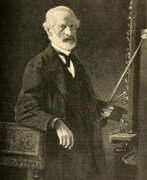

Hugo Crola was a German painter, son of the landscape artists Elise and Georg Heinrich Crola.
Hugo Crola studied at the Düsseldorf Academy of Art and later became a professor. He created images of many aristocratic and wealthy public figures, but is best known for his portraits of fellow artists.
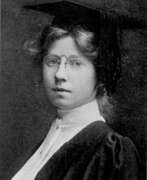

Imogen Cunningham was an American photographer known for her botanical photography, nudes, and industrial landscapes. Cunningham was a member of the California-based Group f/64, known for its dedication to the sharp-focus rendition of simple subjects.
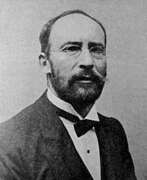

Meijer Isaac de Haan was a Dutch painter. In 1874, he was accepted into the Rijksacademie van beeldende kunsten at Amsterdam. In 1880, one of his works was exhibited at the Paris Salon. That same year, an illustration of de Haan's picture Een moeilijke plaats in de Talmoed appeared in the newspaper Eigen Haard, which generated much published discussion (not so much aesthetic as theological). He enjoyed some success in the Netherlands as a painter of Jewish genre works. In Amsterdam de Haan painted portraits and took on several pupils. De Haan remained in Amsterdam until 1888, where he produced chiefly portraiture, and representations of working class Jews. His early work was inspired above all by the masters of the Dutch school, such as David Teniers and Rembrandt. The example of 17th century painting is reflected in his history painting of 1877–1888.
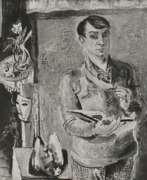

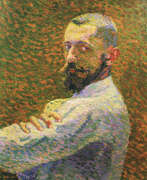

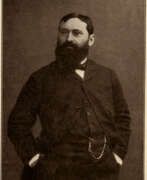

Giuseppe de Nittis was an Italian painter associated with the Macchiaioli movement, which emerged at the end of the 19th century as a reaction to the traditional academic style of painting.
Giuseppe de Nittis first studied at the Neapolitan Academy of Fine Arts before moving to Paris in 1868, where he was influenced by the Impressionist movement and the work of Édouard Manet and Edgar Degas. He quickly gained recognition for his ability to skilfully convey light and atmosphere in his paintings.
De Nittes' style can be described as a mixture of realism and impressionism. He often depicted city scenes, landscapes and portraits. His work is characterised by a loose brushwork, vivid colours and a strong sense of observation.
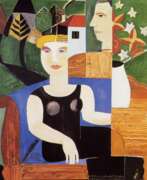

Gustave Franciscus De Smet was a Belgian painter. Together with Constant Permeke and Frits Van den Berghe, he was one of the founders of Flemish Expressionism. In 1908, he and his wife followed Léon to the artists' colony in Sint-Martens-Latem. There, they initially came under the influence of Luminism and the painter Emile Claus, who lived in nearby Astene. At the beginning of World War I, he and his family joined his friend, Van den Berghe, and fled to the Netherlands. From 1914 to 1922, they moved about, visiting and staying at the art colonies in Amsterdam, Laren and Blaricum.[2] His meeting with the Expressionist painter Henri Le Fauconnier marked a turning point in his style which, up until then, owed much to Cubism. In 1927, he settled in Deurle. It was there that his mixture of Expressionism and Cubism peaked, with a series of works depicting circus, fairground and village scenes. After his death in Deurle at the age of sixty-six, his house was preserved as a local museum.
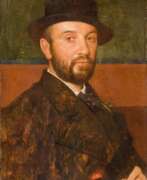

Jules-Élie Delaunay was a French academic painter.
He was awarded a first-class medal at the Paris Exposition of 1878, and the medal of honor in 1889. In 1878 he became an officer of the Legion of Honor, and the following year was made a member of the Institute.
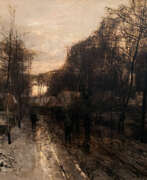

Gustave Den Duyts was a Belgian painter, watercolourist, pastelist, etcher and graphic artist, known for his landscapes. His graphic work quickly gained attention. His etchings won him a prize in 1875 in the competition run by the journal "Journal des Beaux-Arts". On the other hand, at the Fifth Exhibition of the Vereniging der Gentsche Kunstoefenaren his painting received criticism because of being too modern. Its indefinite forms forced the viewer to squint in order to make it out and this vagueness of definition is now regarded as a forerunner of Flemish impressionism. Much of his work was townscapes or landscapes with a melancholic feeling, often with a setting sun or a rising moon and typically done in autumn or winter. The landscapes are usually bare, skeletal and stylized, betraying the fact that he was a skilled etcher, but never detailed. Human or animal figures are not sharply defined but appear to dissolve into the background.
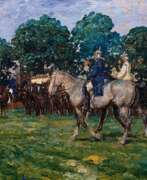

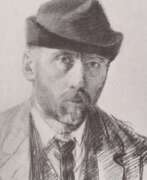

Frans Deutman was a Dutch painter. He graduated from the Antwerp Academy of Arts, a pupil of Charles Verlat. He belonged to the Laren School of painting, a direct continuation of the Hague School.
Frans Deutman is known for his portraits and figures in interiors.


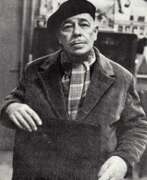

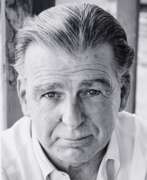

Sir William Dobell was an Australian portrait and landscape artist of the 20th century. Dobell won the Archibald Prize, Australia's premier award for portrait artists on three occasions. The Dobell Prize is named in his honour.
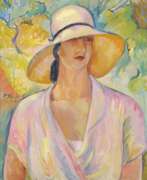

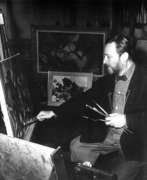


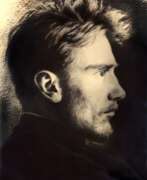

Grigory Kononovich Dyadchenko (Russian: Григорий Кононович Дядченко) was a Ukrainian artist and educator, born on October 8, 1869, in Kirilovka. Known for his landscape and portrait paintings, Dyadchenko's work embodies the realism movement. He studied at the Kyiv Drawing School and later graduated from the Imperial Academy of Arts in St. Petersburg, where he earned multiple awards.
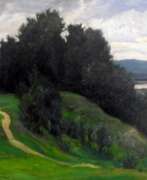
Dyadchenko's artistry is evident in his poetic landscapes such as "Evening on the Dnieper" and "Kiev. View of Podil," which are characterized by their atmospheric depth and emotional resonance. His portraits, including "Head of a Girl" and the depiction of sculptor F. Balavensky, are celebrated for their psychological insight.
Dyadchenko also contributed to art education by teaching at the Kyiv Drawing School, influencing future artists like Mykhailo Kozyk and Vasyl Sylvestrov. His works are preserved in the National Art Museum of Ukraine and other prominent collections.
For those interested in Dyadchenko's art, sign up for updates on new product sales and auction events related to his masterpieces.

Karl Felix Eisengräber was a German painter. He began his studies at the Leipzig Academy of Art, after which he studied at the Academy of Fine Arts, Munich under Ludwig von Herterich and Paul Hoecker. He was a member of the Luitpold Group, which had split off from the Munich Artists' Association, and of a group called The Independents (Die Unabhängigen). After World War I, by arrangement with Springer Verlag, Eisengräber provided the illustrations for new editions of medical books by Ferdinand Sauerbruch.
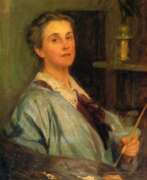

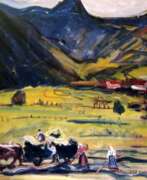

Alphonse Epple was a German landscape, portrait and ecclesiastical painter. In 1919 he studied at the Stuttgart School of Applied Arts under Bernhard Pancock. Presumably, he learned there the technique of fresco painting, the skill in which brought him commissions in later years. His passion was the depiction of religious subjects. In addition to paintings on religious motifs, he painted portraits of friends and acquaintances, landscapes depicting the idyll of his native nature or reflecting an interest in the rural and folk way of life. Apple uses a free, fast brush to capture the ever-changing lighting situation. His oil paintings are characterized by impasto application of paint, and the influence of the Impressionists is especially noticeable in the depictions of landscapes. Completely abandoning contours, Epple formed his compositions from wide dotted lines located side by side.
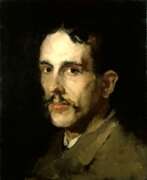

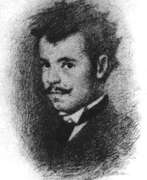

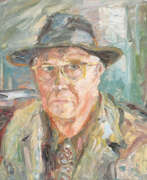

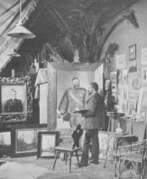

Georg Fischhof was an Austrian portrait, figure and landscape painter.
Fischhof initially studied architecture, but later devoted himself to painting and studied at the Vienna School of Applied Arts and in Munich. After his return to Vienna he shifted his work to the painted imitation of tapestries. Frequent subjects are Dutch coastal and harbour views, Italian landscapes by the water and rural scenes with a stream or path. In almost every work there are sketched persons / children with only suggested facial features, often a column of smoke from a chimney and in seascapes frequently seagulls in flight, in Italian views umbrella acacias and cypresses.


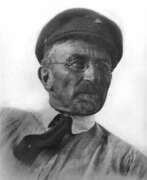

Poppe Folkerts was a German marine painter, draughtsman and graphic artist. He studied at the Berlin Academy of Fine Arts under Karl Salzmann. In 1907 and 1908 he studied figure and portrait painting in Düsseldorf with Eduard von Gebhardt, before going to Paris in 1909, where he was accepted at the Académie Julian.
Poppe Volkerts is considered one of the most outstanding artists of the Frisian coast. As an enthusiastic sailor, he was able to capture the peculiarities of this landscape, the struggle of people with the forces of nature and the fascination of the sea with its constantly changing weather conditions and moods, with a unique liveliness and intensity. His pastose application of paint, special lighting and pure colours create the spatial depth and radiance inherent in the paintings.
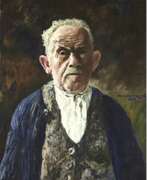


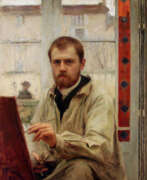


Frederick Carl Frieseke was an American Impressionist painter who spent most of his life as an expatriate in France. An influential member of the Giverny art colony, his paintings often concentrated on various effects of dappled sunlight. He is especially known for painting female subjects, both indoors and out.
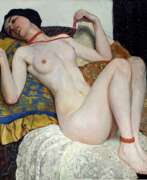

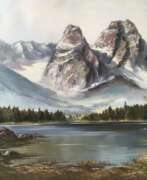

Karl Gatermann the Elder was a German painter and graphic artist. He was the uncle of artist Karl Gatermann, who is typically called "Karl Gatermann the Younger" to distinguish between the two. In 1910 he received the First Prize for Painting of the City of Munich for the oil painting Life. From 1919 to 1942 he lived and worked in Lübeck. In Berlin in 1923 and 1925, he exhibited his watercolors in the galleries of Rudolf Wiltschek and in the Kunsthaus Heumann in Hamburg in 1926. Gatermann's watercolors were also shown in England and in the London Times. Gatermann predominantly focused on north German landscapes and cities, though he also painted still life and figurative scenes, and portraits of people.


Walter Geffcken was a German painter best known for his Rococo scenes. From 1889 to 1891 Geffcken attended Heinrich Knirr's private art school in Munich. 1891-1894 he studied at the Académie Julian in Paris. He then moved to Italy, from where he sent monochrome still lifes to exhibitions in Munich around 1897. There he worked for the magazine Jugend from 1905 and regularly exhibited in the Glaspalast. He was a member of the "Luitpold Group", a moderate association of artists that had emerged from the "Münchner Künstlergenossenschaft". In 1926 he was listed as Professor Walter Geffcken as a member of the admissions jury of the "Künstlerbund Bayern"; he had held the title since about 1916. In addition to rococo scenes, Geffcken also painted peasant pictures, interiors, landscapes and portraits.
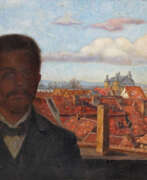

Carl Friedrich Wilhelm Geist was a German Impressionist painter. In 1888, he entered the Academy of Fine Arts, Karlsruhe. With a scholarship from the Grand Ducal Ministry of the Interior, he undertook further studies in Munich, Vienna and Italy. In 1900, he exhibited at the Glaspalast. Although he was officially enrolled at Karlsruhe until 1905, he actually pursued his studies in Stuttgart. He briefly lived in Darmstadt, then returned to Grünberg in 1905 although, as a free-lance painter, he travelled frequently to visit his clients. After 1915 he lived in Wimpfen. World War I hit him very hard; especially the loss of friends such as August Macke and Franz Marc. In response, he abandoned impressionism for a gloomier Academic style.
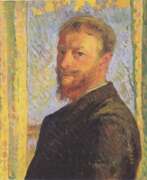

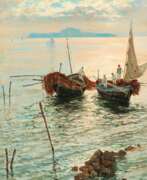


Norbert Goeneutte was a French impressionist painter, printmaker, and illustrator.
Goeneutte is best known as the author of drawings for the novel Earth by Emile Zola. He also created more than 150 etchings and lithographs.
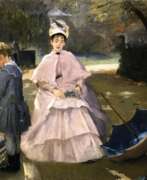

Eva Gonzalès was a distinguished French painter known for her significant contributions to the Impressionist movement. Despite her association with the Impressionists, Gonzalès' style was unique and evolved over time, reflecting both her mentor Édouard Manet's influence and her own personal artistic vision. She explored her identity as an artist through self-portraits and often used her sister Jeanne as a model in her depictions of polite daily life. Gonzalès' works were recognized and appreciated during her lifetime, exhibited in prestigious venues, and continue to be celebrated in collections worldwide.
Eva Gonzalès' art is notable for its intimate domestic scenes, often featuring women and children in everyday settings, imbued with a sense of realism and emotional depth. Her experimentation with pastels in the mid-1870s allowed her to achieve a distinct softness and luminosity in her work, particularly in her portrayals of women and flowers. Some of her most celebrated pieces, like "A Loge at the Théâtre des Italiens" and "Nanny and Child," demonstrate her skill in capturing the nuances of light and character, typical of Impressionist objectives.
Her works are held in esteemed institutions such as the Musée d'Orsay and The Metropolitan Museum of Art, where her pieces continue to captivate audiences with their delicate sensibility and nuanced expression. Through her paintings, Eva Gonzalès offers a window into the nuanced interplay of personal and artistic life in 19th-century France, leaving a lasting legacy in the realm of Impressionist art.
For collectors and art enthusiasts keen on exploring the intricate beauty and historical significance of Eva Gonzalès' work, delving into her oeuvre offers a rich journey into the heart of French Impressionism. To stay updated on sales and auctions featuring Gonzalès' works, signing up for updates can provide exclusive insights into opportunities to engage with her artistry.
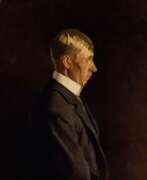

Spencer Frederick Gore was a British painter of landscapes, music-hall scenes and interiors, usually with single figures. He was the first president of the Camden Town Group, and was influenced by the Post-Impressionists.
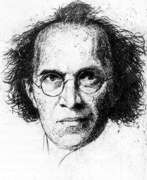

Heinrich Gottselig was a German painter of the first third of the twentieth century of Jewish origin who worked in Germany, France and Russia. He is known as a portrait and landscape painter, impressionist and modernist, and is considered one of the best representatives of the Frankfurt school of landscape and portrait painting.
Gottselig gained recognition at the age of 23 with debut works including portraits and landscapes. In 1913, he was recognized as one of the best representatives of his painting school. In addition to painting, the artist also practiced copper engraving.


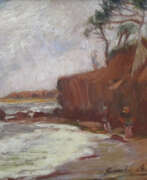

Gwendolyn Muriel Grant was an Australian artist, who worked mostly in portrait work in the Impressionist style. Many of her works have coastal or beach scenes, in addition to formal portraits and she was part of a vanguard of women exhibiting their work in Australia. Gwendolyn Grant was president of the Brisbane Lyceum Club in 1923. She wrote for the local newspapers on art and exhibited her works with the Victorian Artists Society and Society of Women Painters. She regularly entered the Archibald Prize competition. She exhibited her works in 15 solo exhibitions and 4 with her husband. She taught art at the Brisbane CTC until she was 75.
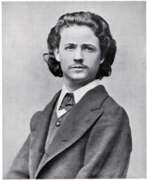

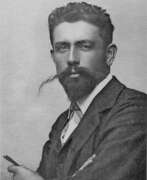


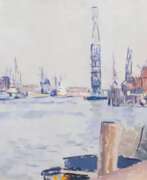

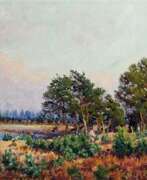

Alfred Hazledine was a Belgian painter and graphic artist. Hazledine was a student of Ernest Blanc-Garin in Brussels and of Adrien-Joseph Heymans. He lived and worked for a long time in Wechelderzande, where there was a true artists' colony. He mainly painted landscapes in Impressionist style. Hazledine was a member of the Vie et Lumière group that brought together Impressionists and Luminists for exhibitions, and was also a member of L'Estampe and of the National Confederation of Painters and Sculptors of Belgium.
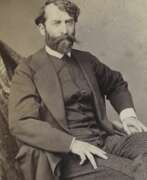

Ferdinand Heilbuth was a nineteenth-century German painter who spent much of his career in France. He is particularly known as a watercolorist, one of the first members of the Society of French Watercolorists.
Heilbuth initially became famous for his portraits done in the style of Titian and Rembrandt. Later, however, he abandoned the portrait genre entirely in favor of historical and everyday subjects and began to depict scenes from the high society of past times. Then, having become a plein air painter, he painted landscapes in Paris and made sketches in London. His paintings were distinguished by their lightness, airiness and masterful technique, and his watercolors were especially skillful.
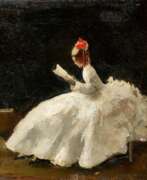

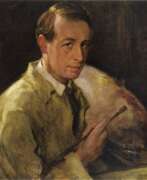

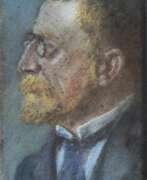

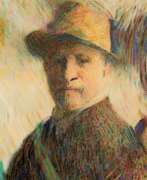

Hugo Curt Herrmann was a German Impressionist and Neo-Impressionist painter; associated with the Berlin Secession. Although he was primarily interested in painting portraits, he also spent some time with the history painter Wilhelm von Lindenschmit at the Academy of Fine Arts, Munich. In 1885, he set up as a portrait painter in Munich and befriended the art critic Richard Muther. In 1893, he moved to Berlin, where he opened a drawing and painting school for women. In 1898, he became one of the founding members of the Berlin Secession and sat on its advisory board. He operated his school intermittently until 1903, when he joined the Deutscher Künstlerbund. He also worked to promote younger artists, such as Arthur Segal, Alexej von Jawlensky, Adolf Erbslöh and others associated with Die Brücke. He was named a Professor at the Royal Academy of Arts in 1917.
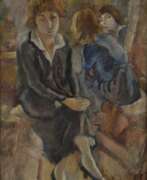

Moritz Heymann was a German painter, graphic artist and art teacher. Heymann initially worked primarily as a graphic artist and exhibited pencil drawings and lithographs. He created portrait and animal studies, especially of horses. Later he mainly showed paintings in exhibitions. From 1914 he often chose circus scenes as a motif for his works. He was a representative of Munich Impressionism.
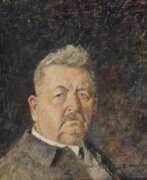

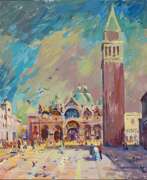

Konrad Honold was a painter, restorer, graphic artist, and heraldist. He began his artistic career at a young age, apprenticing in a painting workshop in Ravensburg. He furthered his training at Toni Kirchmayr's art school in Innsbruck and the Academy of Fine Arts in Berlin. Honold settled in Schruns, Austria, where he worked as a painter and restorer. His works included panel paintings and designs for various mural techniques, focusing mainly on sacred art. He also contributed to the preservation and restoration of church spaces, continuing the tradition of church painting. Honold was involved in heraldry, creating coat of arms for the Vorarlberg State Government and various municipalities in the region. He was an active member of the Montafon Heritage Association and played a crucial role in establishing the Montafon Heritage Museum in its current location.


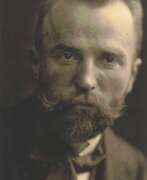

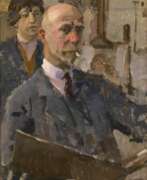

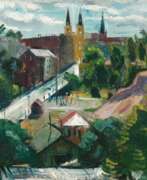

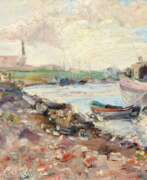

Marcel Jefferis is a Belgian Impressionist painter. He painted figures, genre scenes, landscapes and still lifes in oils and watercolors, and made etchings. His paintings often depict festive demonstrations with many characters. He also designed furniture, wallpapers, fabrics, tapestries and interiors for the Vanderborght company in Brussels.
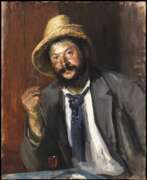

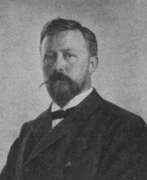

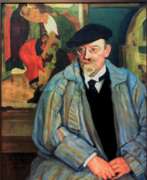

Ivan Semyonovich Kazakov (Russian: Иван Семёнович Казаков) was a Russian painter and graphic artist, known for his contributions to Orientalist art. Born on February 1, 1873, in Kasilova, Oryol Governorate, Kazakov studied at the Moscow School of Painting, Sculpture, and Architecture, and later at the Imperial Academy of Arts under the mentorship of Vladimir Makovsky.
Kazakov's work is notable for its vibrant depictions of Central Asian architecture and landscapes, particularly those of Samarkand, Bukhara, and Tashkent. His paintings often feature detailed portrayals of domes, minarets, and intricate patterns, capturing the essence of these historic cities. This unique focus on Orientalist themes distinguished him from his contemporaries and earned him a prominent place in Russian art history.
Throughout his career, Kazakov exhibited his works in significant venues in Saint Petersburg and Moscow. He also played a crucial role in the art community of Tashkent, where he taught and established his own studio. Several of his works are preserved in museums, including the State Russian Museum and regional art collections, which continue to attract art enthusiasts and collectors.
For updates on new works and auction events related to Ivan Semyonovich Kazakov, sign up for our exclusive alerts. Stay informed about the latest opportunities to acquire pieces by this remarkable artist.


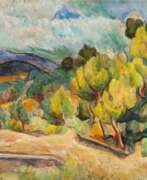

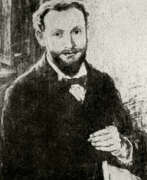

Solomon Yakovlevich Kishinevsky (Russian: Соломон Яковлевич Кишинёвский) was a Russian and Soviet artist of the late 19th and the first half of the 20th centuries of Jewish origin. He is known as a painter, graphic artist and teacher, a prominent representative of the Southern Russian school of painting.
Solomon Kishinevsky worked in domestic, portrait and landscape genres. At the beginning of his career, he was fond of German and Italian classicism, then French impressionism, but the first serious works he created under the strong influence of the Itinerants. His life sketches, scenes from the life of the urban poor were acutely social, the artist has a special attention to the everyday existence of the "little man.
Kishinevsky died presumably in 1941 during the Nazi occupation of Odessa.
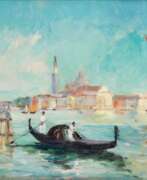

Serge Kislakoff was a French artist and decorator of Russian origin. He is the author of numerous film posters.
Serge Kislakoff painted city views and scenes (Montmartre, Paris boulevards, carnivals in Nice and Cannes), landscapes, harbour views (south of France, Sweden), religious subjects inspired by Old Russian painting. He was also involved in the restoration of church paintings.


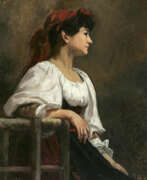


Hermann Joseph Wilhelm Knackfuß was a German painter of the last third of the nineteenth and early twentieth centuries. He is known as a painter who specialized in historical painting and portraiture, art historian and teacher.
Hermann Knackfuß created many historical paintings and murals on the history of Prussia, including murals in the hall of the Strasbourg train station. Early in his career, his work was characterized by a pedantic realism and attention to the details of historical costumes, but over time he introduced Impressionist features into his works. Knackfuß was also known as a portrait painter in demand by the Prussian nobility. He also authored biographies of artists and works on German art history.
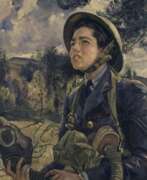

Dame Laura Knight was an English artist who worked in oils, watercolours, etching, engraving and drypoint. Knight was a painter in the figurative, realist tradition, who embraced English Impressionism. In her long career, Knight was among the most successful and popular painters in Britain. Her success in the male-dominated British art establishment paved the way for greater status and recognition for women artists.
In 1929 she was created a Dame, and in 1936 became the second woman elected to full membership of the Royal Academy. Her large retrospective exhibition at the Royal Academy in 1965 was the first for a woman. Knight was known for painting amidst the world of the theatre and ballet in London, and for being a war artist during the Second World War. She was also greatly interested in, and inspired by, marginalised communities and individuals, including Romani people and circus performers.

